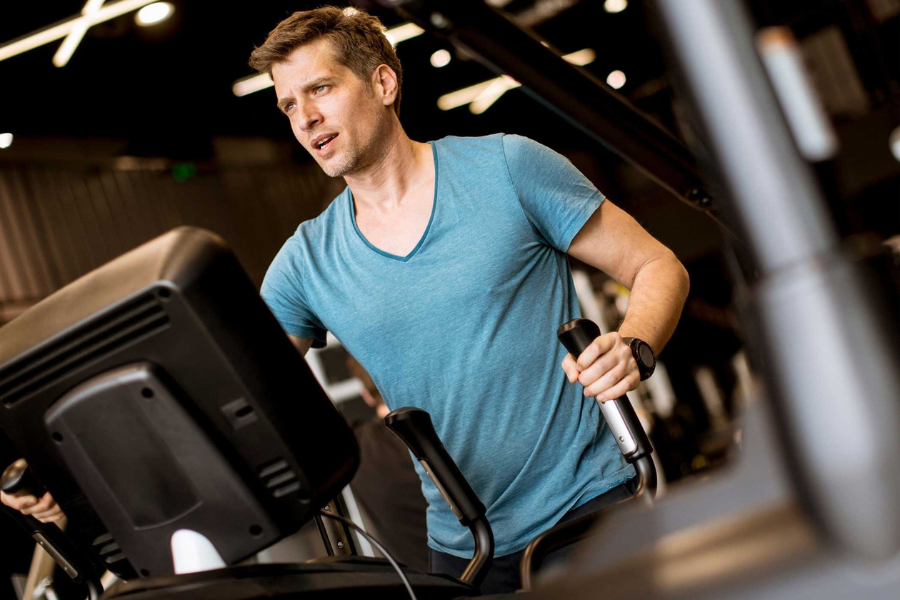
Elliptical interval training can turn a basic cardio session into a powerful, efficient workout. When you follow a structured plan for men’s elliptical interval training, you can burn more calories in less time, build endurance, and protect your joints at the same time. If you want results without pounding your knees on the treadmill, the elliptical is a smart place to start.
Below, you will learn how intervals work, how to set up your machine, and how to use beginner through advanced routines that fit into a busy schedule.
Understand why elliptical intervals work
Elliptical machines engage both your upper and lower body at once. You drive the pedals with your legs while your arms move the handles, which activates your glutes, hamstrings, quads, calves, chest, back, biceps, triceps, and core with minimal joint impact. NordicTrack highlights this joint-friendly, full-body pattern as a key benefit of elliptical training for men who want cardio without the pounding of running.
Interval training simply means you alternate higher intensity work with easier recovery periods. For men’s elliptical interval training, that might look like 1 to 3 minutes of harder effort followed by the same amount of lighter pedaling. According to guidance from Cleveland Clinic, repeating this pattern is an effective way to burn fat and calories without spending an hour on the machine.
When you add resistance and incline, you challenge your heart, lungs, and muscles more. Over time, this improves both cardiovascular stamina and muscular endurance so everyday activities, sports, and even long workdays feel easier.
Set up your elliptical for success
Before you start tapping the interval buttons, a few setup details will make your workouts more comfortable and effective.
Begin by adjusting the stride and handles so you can stand tall with a slight bend in your knees and elbows. You should not feel like you are reaching too far forward or bouncing up and down. Keep your feet centered on the pedals to avoid numbing in the toes or arches and maintain an even pressure from heel to forefoot as you pedal.
If you have incline on your machine, start flat for your first few sessions. As you get comfortable, you can add a 5 to 10 percent incline to recruit more stabilizer muscles and increase lower-body strength. NordicTrack notes that incline work on the elliptical is especially helpful for building muscle endurance and balance in the legs and hips.
Finally, check resistance. On a scale of 1 to 10, your warm up should feel like a 3 or 4. Hard intervals will land closer to a 7 to 9, depending on your fitness level.
Start with beginner-friendly interval training
If you are new to men’s elliptical interval training or returning after a break, ease in so your joints and muscles can adapt. The elliptical is already a low-impact choice for men with arthritis, chronic joint issues, or a history of injuries, which is why many trainers recommend it as a safer alternative to running for cardio and cross-training.
Aim for 15 to 20 minutes, 3 to 4 times per week, as a starting point. Your early sessions focus on building comfort with the motion and developing a cardio base.
A simple beginner pattern looks like this:
- 5 minutes easy warm up at low resistance
- 1 minute moderate effort, 1 minute easy pedaling, repeat 5 to 8 times
- 3 to 5 minutes easy cool down
Your breathing should pick up during the moderate minute, but you should still be able to speak in short sentences. Over several weeks, you can slowly lengthen the total time or add one more interval cycle.
If your machine has preprogrammed options like hill climbs, intervals, or flat walks, those can give you guided variations while keeping intensity in a safe range.
Use HIIT for fast, intense sessions
Once you have a basic foundation, you can move into high intensity interval training, or HIIT. This is where men’s elliptical interval training can really shine if you are short on time.
HIIT sessions alternate short bursts at about 80 to 95 percent of your maximum heart rate followed by lower intensity recovery periods. NordicTrack notes that elliptical HIIT can generate impressive fitness results in as little as 15 minutes, using short, powerful efforts paired with active rest.
A classic HIIT structure on the elliptical is:
- 5 minute warm up, easy pace
- 30 seconds very hard effort, 15 seconds light pedaling, repeat 10 to 12 times
- 5 minute cool down
Another option uses longer efforts:
- 5 minute warm up
- 60 seconds high intensity, 30 seconds recovery, repeat 8 to 10 times
- 5 minute cool down
Cleveland Clinic highlights similar work to rest patterns, such as 3 minutes hard followed by 3 minutes active recovery, as effective for burning fat and calories when repeated in cycles.
You should always keep the pedals moving during recovery. That keeps blood flowing and helps clear fatigue so you can attack the next work interval safely.
Choose between steady state and intervals
Not every day needs to be an all-out effort. Steady state elliptical training, where you maintain a consistent moderate intensity for a longer stretch, also has a place in your weekly plan.
Sunny Health & Fitness describes steady state as holding your heart rate at roughly 60 to 80 percent of your maximum for the entire session. This approach helps you build a strong aerobic base and endurance, often with less perceived strain than HIIT, and with a lower risk of overuse injuries.
Intervals, on the other hand, are better when you want:
- Higher calorie burn in less time
- Bigger cardio challenge
- Greater variation to keep workouts interesting
A balanced approach is to alternate them. For example, you may schedule two steady state days at 20 to 30 minutes each and two interval days that are shorter but more intense. That mix keeps your body progressing without grinding you down.
Think of steady state as building the engine and interval training as testing how fast and powerful that engine can go.
Use incline and resistance to build muscle endurance
While the elliptical is primarily a cardio machine, you can still develop muscular endurance when you use resistance and incline strategically. NordicTrack notes that resistance-based elliptical workouts help build endurance in the quadriceps, hamstrings, glutes, calves, chest, back, core, and arms, even though they do not replace heavy lifting for maximum strength.
To target your lower body more, try:
- Increasing resistance by 1 or 2 levels during work intervals
- Adding a 5 to 10 percent incline for hill-style efforts
- Keeping your heels pressed gently into the pedals to engage glutes and hamstrings
To challenge your upper body, lightly grip the handles and actively push and pull through the entire range of motion instead of letting your legs do all the work. You should feel your chest and back working, not just your arms.
An incline builder session might look like:
- 5 minute flat warm up
- 2 minutes at moderate incline and resistance, 2 minutes flat and easier, repeat 6 to 8 times
- 5 minute cool down
This style of men’s elliptical interval training not only boosts cardio capacity but also conditions the muscles that support strong posture and stability.
Match interval plans to your fitness level
Your fitness level and schedule will determine how you structure your week. Below is a simple way to think about it.
| Level | Weekly structure | Focus |
|---|---|---|
| Beginner | 2 steady sessions, 1 short interval session | Comfort and basic stamina |
| Intermediate | 2 interval sessions, 1–2 steady sessions | Endurance and fat loss |
| Advanced | 3 intense interval or mixed sessions, 1 easy day | Performance and conditioning |
Men new to elliptical intervals are often better off starting with moderate aerobic intervals, then progressing to HIIT once they can complete 20 to 30 minutes of steady cardio comfortably. Sunny Health & Fitness recommends building that foundation before attempting the hardest styles of intervals, and notes that lower intensity options like LIIT and MIIT are ideal stepping stones.
No matter your level, schedule at least one lighter day between hard sessions to allow recovery. If you feel your legs are still heavy or your heart rate is unusually high for a given effort, take it as a sign to back off for a day.
Boost calorie burn and support weight loss
If weight management is one of your goals, men’s elliptical interval training can help you burn a meaningful number of calories in sessions that fit into a lunch break. Research suggests that a 150 pound person burns roughly 170 calories during 30 minutes of moderate intensity elliptical work, and 30 minute interval sessions can burn approximately 270 to 400 calories depending on body weight, speed, incline, and resistance.
HIIT also comes with an added benefit known as the afterburn effect. After a hard interval workout, your body continues to consume more oxygen than usual as it recovers, which means you burn more calories for an hour or longer after stepping off the machine. This effect can make HIIT especially helpful when you want to maximize fat loss and support better metabolic health.
To get the most from your efforts:
- Keep your recovery periods truly easy so you can push harder on the work intervals
- Use both incline and resistance to avoid coasting
- Track your time and perceived effort so you can see progress week to week
Paired with mindful eating and strength training, elliptical intervals can be a cornerstone of a sustainable fat loss plan.
Stay safe and get more from each workout
Elliptical training is low impact, which is one reason it suits men with joint pain, arthritis, or past injuries. It lets you maintain or improve your fitness while placing much less stress on knees, hips, and ankles compared to high-impact exercises like running or plyometrics.
To keep your training safe and productive:
- Warm up thoroughly before every interval day
- Stop or reduce intensity if you feel sharp pain, dizziness, or chest discomfort
- Maintain good posture, with your head up and shoulders relaxed
- Check your machine regularly for worn belts, loose handles, or damaged pedals so you avoid slips or awkward movements
Consistent tracking can also keep you motivated. If your machine syncs with an app such as SunnyFit you can follow structured programs, log your sessions, and watch your numbers improve over time, from distance and resistance to heart rate trends.
Putting it all together
Men’s elliptical interval training gives you a practical way to combine cardio, muscular endurance, and joint-friendly movement into one routine. Start with short, moderate intervals to build a base, then layer in HIIT sessions, incline, and resistance as your fitness improves.
Choose a plan that fits your schedule, listen to your body, and adjust intensity as needed. With a few weeks of consistent effort, you will notice better stamina, stronger legs and core, and more confidence every time you step on the machine.
About the Author