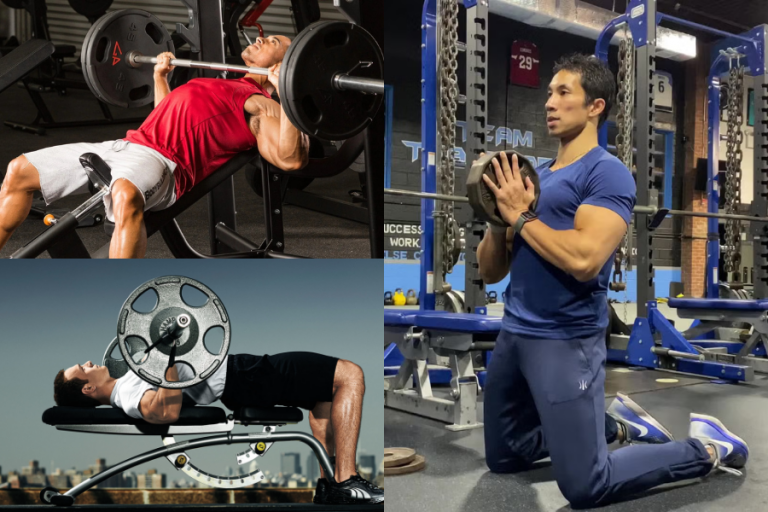
A solid chest workout routine for men does more than build bigger pecs. It improves posture, helps your shoulders feel more stable, and makes everyday pushing tasks feel easier. To get real results, you need a plan that trains your entire chest, not just the part you see in the mirror.
In this guide, you will learn how to train all three areas of your chest, how often to work out, and how to structure a chest workout routine for men that fits your schedule and equipment.
Understand your chest muscles
If you want better results, it helps to know what you are actually training. Your chest is not just one flat slab of muscle. The main muscle, the pectoralis major, has three parts that run in slightly different directions:
- Upper chest fibers, called the clavicular head
- Middle chest fibers, called the sternal head
- Lower chest fibers, sometimes called the abdominal head
Because these fibers run in different directions, certain exercises will emphasize one area more than another. When you press on an incline, you hit more upper chest. When your torso is more upright and your arms move slightly down, you load more of the lower chest.
For a complete chest, you want to:
- Hit upper, middle, and lower fibers
- Use at least one heavy compound lift
- Include movements that pull your arms across your body, known as horizontal adduction, so the chest works through its full range of motion
How often you should train chest
Most men see the best chest growth when they train chest 1 to 3 times per week, depending on experience and recovery.
If you are a beginner, one or two focused chest sessions per week is usually enough to grow. You are still adapting to lifting, so you do not need a lot of volume to see progress. For more experienced lifters, two chest-focused days each week typically works well, as long as you give yourself 2 to 3 days between hard sessions so your muscles can repair and grow.
Most effective chest workouts last 30 to 60 minutes and include 4 to 6 exercises, with 3 to 4 sets per movement. That is long enough to stimulate growth if you train with intent, but not so long that your form falls apart.
Recovery matters just as much as your workout. To support chest development, you should:
- Get consistent, quality sleep
- Eat enough protein, around 1 gram per pound of body weight per day, to support muscle repair
- Pay attention to other pressing work for shoulders and triceps so you are not overworking the same joints every day
Key principles for building your chest
Before you jump into a full chest workout routine for men, it helps to understand a few simple principles that guide exercise choice and programming.
Train all three chest regions
You will get better results when your program targets:
- Upper chest, using incline presses and low to high cable flies
- Middle or inner chest, using flat presses and horizontal cable crossovers
- Lower chest, using dips, decline work, and high to low cable flies
Ignoring one area, especially the upper chest, often leads to a chest that looks flat near your collarbones and more developed lower down.
Combine heavy compounds and focused isolation
For size and strength, you want both:
- Compound lifts, such as bench press, incline bench press, and dips, to move heavy loads and recruit a lot of muscle
- Isolation or focused movements, such as dumbbell flyes and cable crossovers, to work through a long range of motion and really squeeze the chest
A balanced workout typically starts with compound exercises when you are fresh, then finishes with isolation work when your muscles are already tired.
Use effective rep ranges
For most men who want bigger pecs, moderate weights with 6 to 12 reps per set and 3 to 4 sets per exercise are ideal. This rep range gives you enough load to build strength and enough total work to trigger muscle growth.
If you want to include some heavier strength work, you can add 2 to 6 rep sets at the start of your workout for your main press, for example, bench press. Just make sure you keep your form strict. Sloppy, half range reps will not help you grow faster.
Best gym chest workout routine for men
If you have access to a gym with barbells, dumbbells, and cables, you can follow this structured routine that covers upper, middle, and lower chest and uses full range midline movements.
Session structure
You will pair heavy compound overload exercises with cable crossover work so the chest is trained through its full range of motion. A typical layout looks like this:
- Flat barbell bench press paired with horizontal cable crossover
- Incline dumbbell bench press paired with low to high cable crossover
- Weighted dips paired with high to low cable crossover
For each compound lift, perform 4 sets at different rep targets, such as 6, 8, 10, and 12 reps, increasing or decreasing weight as needed. After each set of the main lift, move directly into 15 reps of the corresponding cable crossover before resting. This creates a demanding but effective drop set style that drives muscle activation and blood flow.
Example gym chest workout
Here is how a full chest workout routine for men might look:
- Flat barbell bench press + horizontal cable crossover
- Bench press: 4 sets, 6, 8, 10, 12 reps
- Immediately followed by horizontal cable crossover: 4 sets, 15 reps
- Rest after completing both moves, then repeat
- Incline dumbbell bench press + low to high cable crossover
- Incline dumbbell press: 4 sets, 6, 8, 10, 12 reps
- Immediately followed by low to high cable crossover: 4 sets, 15 reps
- Focus on controlling the lowering phase and squeezing your upper chest at the top
- Weighted dips + high to low cable crossover
- Dips: 4 sets of 8 to 12 reps, add weight if bodyweight is too easy
- Immediately followed by high to low cable crossover: 4 sets, 15 reps
- Lean slightly forward on dips to emphasize lower chest rather than triceps
This style of training is intense, so you will want at least 48 hours before your next chest-focused session. Many men pair this heavier, lower rep day with a second, lighter chest day later in the week that uses more moderate loads and higher reps for extra volume and definition.
Beginner friendly chest workout
If you are newer to strength training, you can still build a strong chest without using complex setups. Focus on basic pushing patterns, learn good form, and let small weight increases drive your progress.
Simple gym-based beginner workout
You can start with the essentials:
- Barbell bench press
- 3 sets of 6 to 12 reps
- This classic movement involves the chest, shoulders, and triceps and is a proven builder of size and strength
- Incline chest press, with barbell or dumbbells
- 3 sets of 6 to 12 reps
- Target your upper chest, which can be harder to grow, and focus on smooth, controlled reps
- Dumbbell flyes
- 3 sets of 10 to 15 reps
- Use lighter weights and concentrate on feeling the stretch and squeeze through your chest rather than just moving your arms
- Push ups
- 2 to 3 sets to about 10 controlled reps per set
- Keep your body in a straight line, lower slowly, and push hard through the floor
You can run this workout 1 or 2 times per week. Start with weights that let you keep good form. As your technique improves, gradually increase the load within the same rep ranges.
Chest workout routine for home
You do not need a full gym to build your chest. With just your body weight, a pair of dumbbells, or a resistance band, you can train upper, middle, and lower chest.
Bodyweight chest workout
Use push up variations to shift emphasis across your chest:
-
Decline push ups for upper chest
Place your feet on a stable bench or step and your hands on the floor. This angle loads the area near your collarbones more. -
Standard push ups for mid chest
Hands under your shoulders, body straight, chest lowering close to the floor. This is your baseline movement for chest, shoulders, and triceps. -
Incline push ups for lower chest
Place your hands on a bench or sturdy surface and your feet on the floor. This slight incline shifts some emphasis lower.
Aim for 3 to 4 rounds of 8 to 15 reps of each variation, resting 45 to 60 seconds between sets. If regular push ups are too hard, start with hands elevated push ups and work your way down to the floor.
For more challenge, you can use weighted push ups or band resisted push ups. Some routines even emphasize driving one hand slightly across your body in banded push ups to increase midline adduction and engage the chest more fully.
Simple home dumbbell or band workout
If you have a pair of dumbbells or a resistance band, you can mimic many gym movements:
- Flat floor press or banded press
- Incline press using a bench or stacked pillows to raise your upper body
- Dumbbell or band fly, focusing on a slow stretch and strong squeeze
You can structure these in the same 3 sets of 8 to 12 reps format, training 1 to 2 times per week and resting at least a day between sessions that hit your chest hard.
Pairing chest with other muscle groups
In a typical weekly plan, you can train chest alone or with other upper body muscles. Many men like to pair chest with:
- Triceps, since pressing exercises already work them
- Shoulders, especially front delts, that share similar movement patterns
- Back and biceps for an upper body day that balances pushing and pulling
If you train chest twice per week, consider one day as a chest and triceps focus and another as an upper body day. This approach spreads your volume, helps you practice your lifts more often, and can speed up progress without overloading one session.
Putting your routine together
To design a chest workout routine for men that delivers real results, keep these points in mind:
Train your chest 1 to 3 times per week, hit all three regions of the pecs, and balance heavy compound lifts with smart isolation work. Then let recovery and nutrition support the growth you trigger in the gym.
You do not have to overhaul everything at once. Start by picking one change to make in your next workout, such as adding an incline pressing move or including cable crossovers that pull your arms across your chest. As you get comfortable, build up to a full routine that you can stick with for several weeks.
Consistency, not complexity, is what will give you the stronger, fuller chest you are working toward.
About the Author