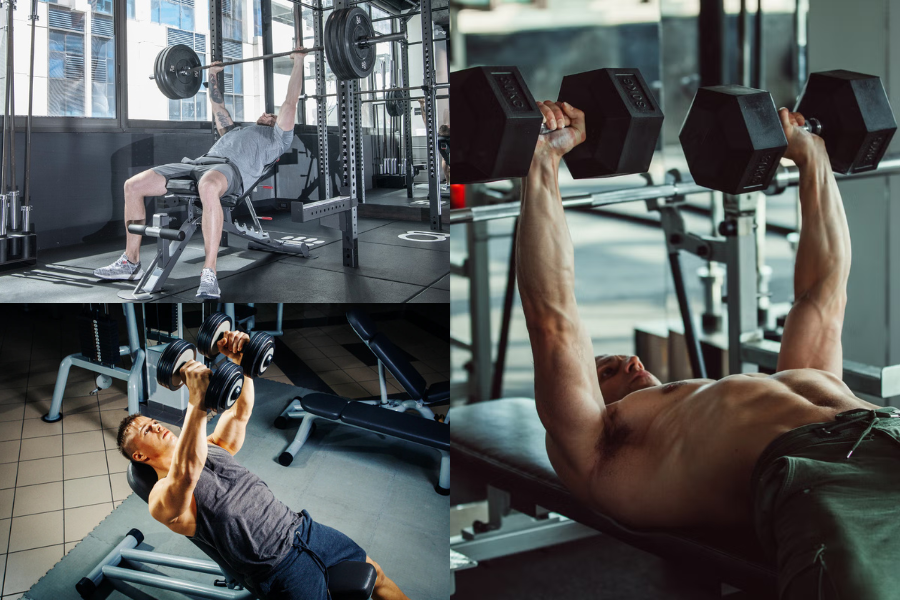
A strong chest is about more than how you look in a T‑shirt. The right chest exercises for men improve posture, support your shoulders, and boost pressing strength for everything from push-ups to overhead lifts. With a smart plan, you can build your upper, mid, and lower chest without living in the gym.
Below, you will learn how your chest muscles work, the best chest exercises for men in the gym and at home, and how to put them together into simple routines that drive muscle growth.
Understand your chest muscles
Before you load up the bar, it helps to know what you are training. Your main chest muscle, the pectoralis major, has three key areas that respond slightly differently depending on the exercise:
- Upper chest (clavicular head) along your collarbone
- Mid chest (sternal head) across the middle of your chest
- Lower chest (abdominal head) toward your ribs and upper abs
The fibers in each area run in different directions. That is why changing the angle of your press or fly changes what you feel. For a well developed chest, you want to:
- Hit all three regions across the week
- Use movements that bring your arms across your body, not just straight up and down
- Include heavier compound lifts plus lighter isolation work for full range of motion
When you think of your training this way, it becomes easier to spot gaps. If you only flat bench and never incline, for example, your upper chest will usually lag behind.
Best compound chest exercises for men
Compound lifts let you move the most weight and build the most overall size and strength. Make one or two of these the foundation of each chest workout.
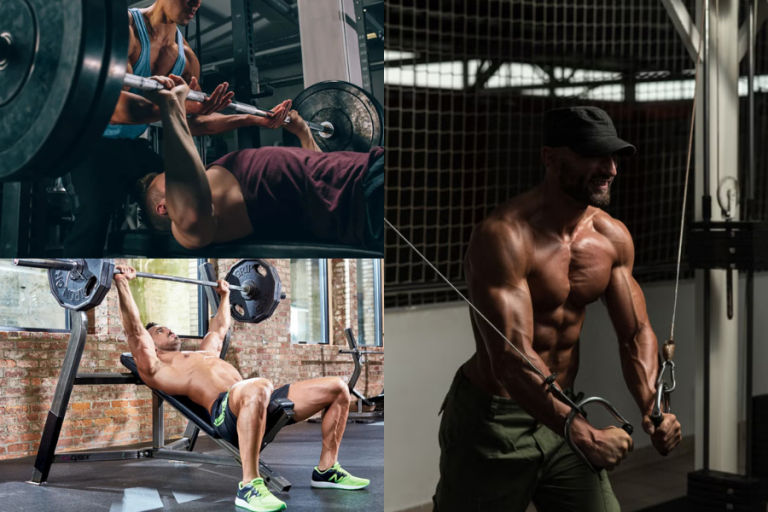
Barbell bench press
The classic bench press is still one of the best chest exercises for men to overload the mid chest.
How to do it:
- Lie on a flat bench with your eyes under the bar.
- Plant your feet, squeeze your glutes and brace your abs.
- Retract your shoulder blades into the bench so your chest is lifted.
- Grip the bar slightly wider than shoulder width.
- Lower the bar to around your mid chest with your upper arms at roughly a 45 degree angle to your torso, not flared out to 90 degrees.
- Press up, driving through your feet and squeezing your chest at the top.
Keeping your arms at that 45 degree angle reduces shoulder stress and helps you feel the pecs more, as highlighted by Men’s Health fitness director Ebenezer Samuel in 2023.
Work in the 3 to 4 sets of 6 to 8 reps range if strength and size are your main goals.
Incline bench press
Incline pressing shifts more work to your upper chest around the collarbone. Gymshark notes that upper chest exercises such as incline presses help create a lifted, fuller look that stands out from the side, which many men want in their physique.
Set the bench between 30 and 45 degrees:
- Too low and it is almost a flat press
- Too high and it becomes more of a shoulder exercise
Keep your forearms perpendicular to the floor at the bottom of each rep regardless of bench angle to avoid overloading your shoulders.
Perform 3 to 4 sets of 8 to 10 reps.
Weighted dips
Dips are excellent for the lower chest and overall pushing strength.
- Grip parallel bars and support your body with straight arms.
- Lean your torso slightly forward to shift tension from triceps to chest.
- Lower until your elbows are roughly 90 degrees, feeling a stretch in the lower chest.
- Press back up and think about driving your body away from the floor with your chest.
Start with bodyweight for 2 to 3 sets of as many quality reps as you can. When that feels comfortable, add weight with a belt or hold a dumbbell between your feet.
Push-up variations
Push-ups remain a staple chest exercise for men, and they work almost anywhere.
Standard push-ups: keep a straight line from head to heels, lower until your chest is just above the floor, and press back up while keeping your elbows at about 45 degrees to your body.
Advanced variations like clap push-ups, band resisted push-ups, and typewriter push-ups increase power and time under tension. Many people on Reddit report noticeable pec growth over time with high volume push-ups, such as 300 to 400 per day spread into sets.
Best dumbbell chest exercises
Dumbbells offer a greater range of motion than barbells and allow each arm to work independently. This helps fix strength imbalances and is easier on your joints, as several 2024 guides on dumbbell chest workouts emphasize.
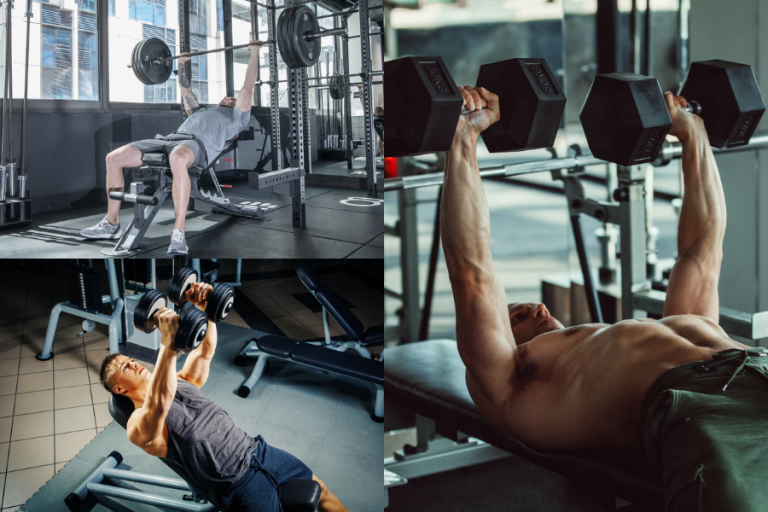
Dumbbell bench press
The dumbbell bench press is one of the best chest exercises for men to build size and strength, particularly if barbell benches bother your shoulders.
Key tips:
- Lie on a flat bench with a dumbbell in each hand, palms facing forward.
- Retract your shoulder blades and keep your feet planted.
- Lower the dumbbells to the sides of your chest, forearms vertical.
- Press up and slightly in, finishing with the dumbbells above your mid chest.
Aim for 3 to 4 sets of 6 to 8 reps with a weight that challenges you but still lets you control the bottom position.
Incline dumbbell press
Incline dumbbell presses are especially effective for targeting your upper chest by changing the angle of tension. A 30 to 45 degree incline increases activation of the upper pec fibers and can help correct imbalances between left and right sides.
Use 3 to 4 sets of 8 to 10 reps. Focus on a deep stretch at the bottom and a controlled press rather than rushing.
Dumbbell chest fly
Flyes focus on adduction, or bringing your arms toward the midline of your body. That is a main function of the pecs and it complements your pressing movements.
- Lie on a flat or incline bench with a dumbbell in each hand.
- Start with the dumbbells above your chest, palms facing each other.
- With a slight bend in your elbows, open your arms in a wide arc until you feel a strong stretch in your chest.
- Bring the dumbbells back together over your chest, squeezing your pecs.
Because this is more of an isolation exercise, keep the weight moderate and control the movement. A common guideline is 3 sets of 10 to 12 reps.
Dumbbell pullover
The dumbbell pullover is often thought of as a back move, but it also trains the upper chest when you focus on bringing the weight back over your chest.
- Lie across a bench with only your upper back supported and hips low, or use a traditional lying position.
- Hold one dumbbell with both hands above your chest.
- Lower it back behind your head in a semicircle while keeping your elbows slightly bent.
- Pull the weight back over your chest and squeeze.
Include this later in your workout for 2 to 3 sets of 10 to 15 reps.
Effective upper chest exercises
If your chest looks flat near the collarbone, you are not alone. Many men need extra work here. Beyond incline presses, there are a few upper chest focused moves that stand out in recent research.
Reverse grip bench press
The reverse grip bench press uses a supinated grip, palms facing you. This variation increases activation in the clavicular (upper) portion of the pec major and even hits the biceps more.
Safety tips:
- Use a spotter if possible, especially while learning the grip.
- Start lighter than your normal bench weight.
- Keep your shoulders pinned to the bench so the chest does the work.
Work up to 3 sets of 6 to 10 reps.
Low to high cable fly
Setting the cables low and flying up and in recruits more upper chest fibers. Biomechanics research in 2022 pointed out that cable work creates greater shoulder joint movement with constant tension, which is ideal for mechanical tension and growth.
- Set both pulleys to the lowest position.
- Step forward with a staggered stance and lean slightly forward.
- Start with hands near hip level and arms slightly bent.
- Sweep the handles up and in so your hands meet at about face height.
- Control the return, feeling a stretch in your upper chest.
Use 3 sets of 12 to 15 slow, controlled reps.
Training the upper chest twice a week with a mix of compound and isolation work, in the 8 to 12 rep range near failure, supports balanced development, better posture, and strong pressing performance, according to Gymshark’s guidance on upper chest training.
Chest exercises at home with little or no equipment
You do not need a full gym to grow your chest. With bodyweight and simple tools like dumbbells or bands, you can still hit every part of your pecs.
Push-up progressions
Start with a version that feels challenging yet manageable and progress over time.
- Incline push-ups, hands on a bench or chair, are easier and target more of your lower chest.
- Standard push-ups balance the whole chest.
- Decline push-ups, feet elevated, hit more upper chest.
- Diamond push-ups emphasize the inner chest and triceps and can be done for 3 to 4 sets of 8 to 15 reps.
- Isometric push-ups involve holding the bottom position, elbows at 90 degrees, for about 15 seconds to spike muscle activation.
If you want to focus on hypertrophy, you can cycle between these variations across the week instead of doing the same style every session.
Home bench and floor presses
No barbell? Use dumbbells or even heavy water bottles.
Flat dumbbell floor press:
- Lie on your back on the floor with a dumbbell in each hand.
- Start with the dumbbells at the sides of your chest, elbows resting lightly on the ground.
- Press up until your arms are straight and squeeze your chest.
- Lower under control until your elbows gently touch the floor again.
Bench press at home with a flat bench or sturdy step lets you go a little deeper for more range of motion. Most home guides recommend 2 to 4 sets of 8 to 15 reps.
Rings and straps
If you have gymnastic rings or suspension straps, you can level up your home chest training.
- Ring push-ups add instability, which forces more stabilizer and chest activation.
- Ring flies, where you open your arms wide and then bring them together in front of your chest, mimic cable flies but with bodyweight.
These tools let you adjust difficulty instantly by changing your body angle.
How to structure your chest workouts
You do not need a complicated plan to see progress. A couple of focused sessions per week, done consistently, will take you a long way.
Weekly frequency and volume
A practical starting point:
- Train chest 2 times per week
- Perform 2 to 5 sets per exercise
- Use 5 to 10 reps per set for strength, 10 to 20, or even 20 to 30 for hypertrophy with lighter weight, as 2024 dumbbell chest guides suggest
If progress stalls after several months, you can increase to 3 chest focused sessions per week as long as your recovery and joints feel good.
Sample gym chest workout
Day 1, heavy focus:
- Barbell bench press, 4 x 6 to 8
- Incline dumbbell press, 3 x 8 to 10
- Weighted dips, 3 x 8 to 12
- Low to high cable fly, 3 x 12 to 15
Day 2, hypertrophy and detail:
- Incline barbell or dumbbell press, 4 x 8 to 10
- Flat dumbbell bench press, 3 x 8 to 12
- Dumbbell fly, 3 x 10 to 12
- Dumbbell pullover, 2 to 3 x 10 to 15
Adjust the total sets based on your recovery. You should finish feeling worked, not wrecked.
Sample home chest workout
Day 1:
- Decline push-ups, 4 sets close to failure
- Standard push-ups or ring push-ups, 3 sets close to failure
- Diamond push-ups, 3 x 8 to 15
- Isometric push-up holds, 3 x 15 seconds
Day 2:
- Flat dumbbell floor or bench press, 4 x 8 to 12
- Incline push-ups, 3 x 10 to 20
- Band or ring fly, 3 x 12 to 20
Home training works if you push your sets near muscular failure and gradually increase either reps, difficulty, or load over time.
Form tips, recovery, and common mistakes
Good technique keeps your shoulders happy and puts the strain where you want it, on your chest.
Technique essentials
- Warm up with light cardio and dynamic shoulder and arm movements before heavy pressing.
- Retract and lightly squeeze your shoulder blades during presses so your chest, not your shoulders, drives the weight.
- Keep your upper arms roughly 45 degrees from your torso during presses instead of flared out. This activates more chest and lats and reduces shoulder strain.
- Brace your abs and squeeze your glutes so your torso stays stable under the weight.
Mind muscle connection matters. Think about pulling your upper arms across your body and squeezing your chest at the top of each rep, rather than just moving the weight from point A to point B.
Avoid these common mistakes
- Ego lifting with weights that are too heavy, which turns clean presses into half reps and shifts tension to your shoulders and triceps.
- Neglecting your back. Rows and other back work help keep your shoulders healthy and your posture balanced.
- Skipping the warm up, which limits range of motion and increases injury risk.
- Only doing flat bench and ignoring upper or lower chest angles.
Consistency beats perfection. Many lifters notice better performance after about 3 to 4 weeks and visible changes in chest size after 6 to 8 weeks of steady training, especially when they pair their workouts with solid nutrition and enough rest.
Support growth with food and sleep
For muscle growth, you generally want:
- Sufficient protein, often around 1 gram per pound of bodyweight per day
- A slight calorie surplus if gaining size is your main goal
- At least 7 hours of sleep most nights
Combined with well chosen chest exercises for men and progressive overload, these basics help you add muscle more quickly and maintain it long term.
You do not have to overhaul your entire routine at once. Start by adding one new exercise for an area that is lagging, such as incline presses for upper chest or flyes for better inner chest activation. Stick with the change for a few weeks, track your reps and weights, and adjust from there. Over time, those small, consistent tweaks are what build a bigger, stronger chest.
About the Author