A defined upper core is one of the first things people notice when you take your shirt off. Upper ab workouts for men are a smart way to build that carved, “armor plate” look just below your chest, but they also play a big role in performance and back health.
This guide walks you through what your upper abs actually are, how to train them effectively, and how to put everything into a simple routine you can follow each week.
Understand what “upper abs” really are
The six pack that you see is one long muscle called the rectus abdominis. It runs from your pubic bone up to your sternum. What you think of as “upper abs” and “lower abs” are just different regions of this same muscle.
According to muscle hypertrophy researcher Brad Schoenfeld, you can emphasize the upper or lower portion with certain exercises, but you cannot truly isolate them as separate muscles. Crunches that curl your ribcage down toward your hips tend to bias the upper abs, while reverse crunches that lift your pelvis toward your ribcage hit the lower portion more.
This matters because it changes how you approach your training. Rather than chasing “upper only” moves, you focus on exercises that put slightly more tension on that top half while still training your entire core as a unit.
Why upper ab workouts matter for men
For men, upper ab development does more than sharpen your physique.
Stronger upper abs help you:
- Brace better on heavy presses, squats, and deadlifts
- Maintain good posture at a desk and under a bar
- Protect your lower back when you twist, reach, and lift in daily life
They also contribute heavily to the square, athletic look many guys want. Well developed upper abs under the chest help create that V taper appearance that frames your torso.
Just remember that visibility is mainly about body fat levels. Direct training will build the muscle, but you also need a consistent calorie deficit and strength training to reveal it. Spot reduction of belly fat with upper ab moves alone is a myth, as highlighted in a 2025 Gymshark article on upper ab workouts.
Technique tips that make every rep count
You can do hundreds of crunches and still not see much progress if your technique is off. To get more out of your upper ab workouts, pay attention to a few key details.
Focus on spinal flexion, not hip flexion
The main job of your rectus abdominis is spinal flexion. That is a forward curling of your spine, like the motion of an old school crunch. When upper ab exercises turn into swinging your legs or yanking your torso up with the hip flexors, your abs stop doing most of the work.
Kinesiologist Jeremy Ethier advises focusing on curling your ribcage down toward your pelvis during top down moves such as situps or cable crunches to keep tension on the abs and reduce hip flexor dominance. Think chest to pelvis, not elbow to knee.
Use a slight posterior pelvic tilt
Tucking your tailbone slightly, also called a posterior pelvic tilt, helps keep your abs loaded and your lower back comfortable. You can do this by squeezing your glutes and bracing your core before you move.
Research cited by Gymshark notes that this tilt reduces hip flexor involvement and increases upper ab activation, especially during crunch variations. It also lowers stress on your lumbar spine during repeated spinal flexion.
Control the tempo
Slow, controlled reps tend to build more muscle than fast, sloppy ones. For upper ab workouts, a 3 1 1 tempo works well:
- 3 seconds to lower under control
- 1 second pause at the stretched position
- 1 second to curl up and squeeze
A 2025 Gymshark review recommends 2 to 4 second eccentrics to maximize tension during spinal flexion movements. Aim for 8 to 15 quality reps per set instead of chasing extreme burn or very high rep counts.
Best beginner upper ab exercises
If you are new to core training, start with moves that teach you how to curl your spine and brace correctly. These options rely on bodyweight and can be done at home or in the gym.
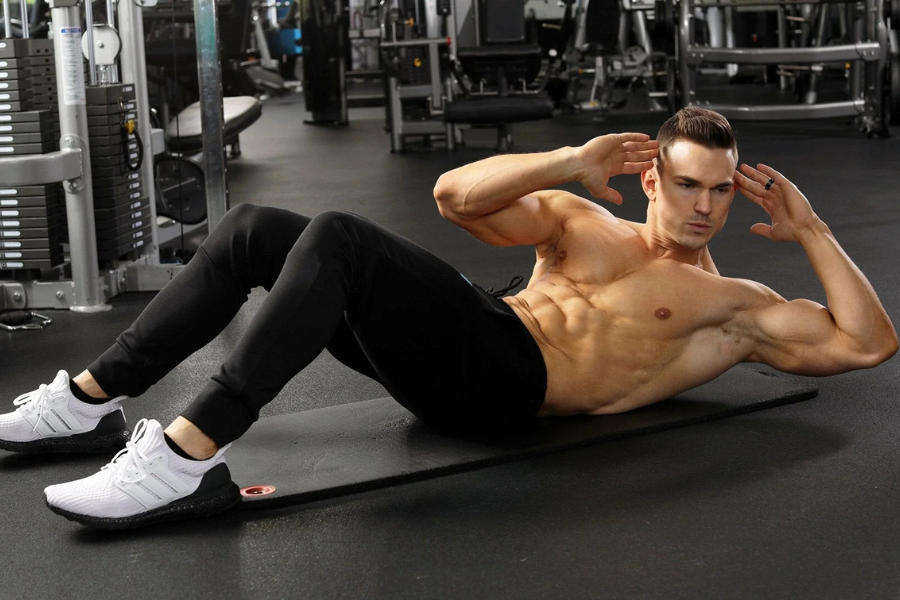
Supine crunch with knees bent
Lie on your back with knees bent and feet flat. Gently tuck your tailbone, then exhale as you curl your ribcage toward your pelvis. Think about lifting your shoulder blades just off the floor, not cranking your neck.
Keep your lower back in light contact with the ground and avoid pulling on your head with your hands. This classic crunch biases the upper portion of your rectus abdominis because your ribs are moving toward your hips.
Toe touches
Toe touches increase the challenge slightly and add a good upper ab squeeze at the top. Lie on your back, lift your legs so your feet are above your hips, then reach your hands toward your toes while curling your ribcage off the floor.
Move slowly, especially on the way down, and keep your gaze up toward your feet instead of toward your knees. This helps keep the work in your abs rather than your neck.
Hollow hold
The hollow hold trains your abs isometrically, which means they stay contracted without moving. Lie on your back, brace your core, then lift your head, shoulders, and legs slightly off the floor so your lower back presses into the ground. Your body should form a gentle “banana” shape.
Core drills such as the hollow hold have been highlighted as effective ways to engage the upper abs while strengthening the entire core for balanced development in recent training reviews. Start with short holds of 15 to 20 seconds and build up over time.
Intermediate and advanced upper ab moves
Once you can feel your upper abs working in the simpler variations, you can progress to exercises that add more resistance or leverage. These are ideal for men who already lift a few times per week and want a thicker, more defined upper six pack.
Stability ball or decline bench crunches
A stability ball extends your range of motion and can increase upper ab activation compared to floor crunches. Research summarized by Gymshark reports higher activity in the upper rectus abdominis during ball crunches versus standard crunches.
Sit on the ball and walk your feet forward until your lower to mid back rests on the ball. Place your hands lightly behind your head, tuck your pelvis, and curl your chest toward your hips. Go only as far back as you can while keeping control.
If your gym has a decline bench, decline crunches are another proven option. The slight decline angle increases the load on your upper abs as you curl up.
Kneeling cable rope crunch
The kneeling cable crunch lets you load your abs like any other muscle with adjustable weight. This move maintains tension even when your spine is more extended, which contributes to a strong contraction through the full range.
Set a rope attachment on a high pulley. Face away or toward the stack, grab the rope, and kneel a step or two back. Fix the rope near your forehead or collarbone, brace with a small posterior pelvic tilt, then curl your ribcage down toward your thighs. Focus on spine movement instead of just bowing your hips.
According to a 2024 Onnit review, cable crunches are among the most effective exercises for fully developing the rectus abdominis as long as spinal flexion is included and your lower back is healthy.
Hanging knee raise crunch
You often see hanging leg raises used for lower abs, but you can bias your upper abs with a crunch style variation. Instead of just lifting your knees, think about pulling your pelvis and ribcage toward each other.
Hang from a bar with your legs slightly in front of you. As you exhale, tuck your pelvis and bring your knees toward your chest while rounding your upper back a little. The hip movement creates lower ab tension and the spinal flexion helps your upper abs contribute, which trains your core as an integrated system.
How often to train your upper abs
Your abs recover relatively quickly, especially when you use bodyweight or moderate loads. Research and expert summaries from Gymshark suggest training upper abs 1 to 3 times per week. If you are using heavier weighted moves like cable crunches or loaded decline crunches, give yourself 48 to 72 hours before you hit them hard again.
You can plug upper ab work into your week in a few ways:
- After upper body workouts, as a 10 to 20 minute finisher
- In a short, dedicated core session on rest days
- At the end of full body workouts so your core fatigue does not limit big lifts
Avoid hammering your abs with very high rep sets every day. Treat them like any other muscle group. Jeremy Ethier notes that providing adequate volume and rest, rather than endless frequent burnout sets, leads to better muscle growth and less fatigue for men working on ab development.
Sample upper ab workout for men
Here is a simple routine that blends focused upper ab work with overall core strength. Do this 2 or 3 times per week, with at least one rest day between sessions.
- Kneeling cable crunch
- 3 sets of 12 to 15 reps
- 3 1 1 tempo, 60 to 90 seconds rest
- Hanging knee raise crunch
- 3 sets of 6 to 12 reps
- Focus on curling your pelvis and ribcage together
- Stability ball crunch or supine crunch
- 2 to 3 sets of 10 to 15 reps
- Pause and squeeze for 1 second at the top of each rep
- Pushup plank with tailbone tucked
- 3 sets of 30 second holds
- Squeeze your glutes and maintain a slight posterior pelvic tilt
This structure mirrors recommendations seen in expert programs, which mix dynamic spinal flexion with isometric core drills for both strength and safety.
If you are newer to training, start at the low end of the set and rep ranges and focus on learning the movements. Progress by adding reps, then weight, then more challenging variations.
Nutrition and body fat still decide visibility
Even the most carefully planned upper ab workouts for men will not show clearly if a layer of fat covers your midsection. That does not mean your training is failing. It simply means the muscle is building under the surface.
Multiple fitness reviews, including work summarized by Onnit, point out that visible abs depend heavily on overall body fat and genetics, not on how many crunches you perform. To see your upper abs more clearly, you will need:
- A small but consistent calorie deficit if your goal is fat loss
- Sufficient protein and strength training to maintain or build muscle
- Patience, since fat loss around the stomach is often slower for men
Think of ab training as shaping and strengthening and your nutrition and overall programming as what reveals the shape.
Put it all together
If you remember just a few things from this guide, make them these:
- Your “upper abs” are part of the same rectus abdominis that forms your entire six pack
- Bias the upper region with controlled spinal flexion such as crunches, decline crunches, and kneeling cable crunches
- Use a posterior pelvic tilt, a slow lowering phase, and a focus on ribcage toward pelvis to keep tension where you want it
- Train your core as a whole, not just the top two or four blocks, to avoid imbalances and support your lifts and daily movement
- Pair your upper ab workouts with sensible nutrition and total body training if you want your results to show
Start with two focused sessions this week. Pick three exercises from the examples above, move slowly, and pay attention to where you feel the work. With a few weeks of consistent practice, you will notice stronger, more responsive upper abs that support everything else you do in the gym.
About the Author