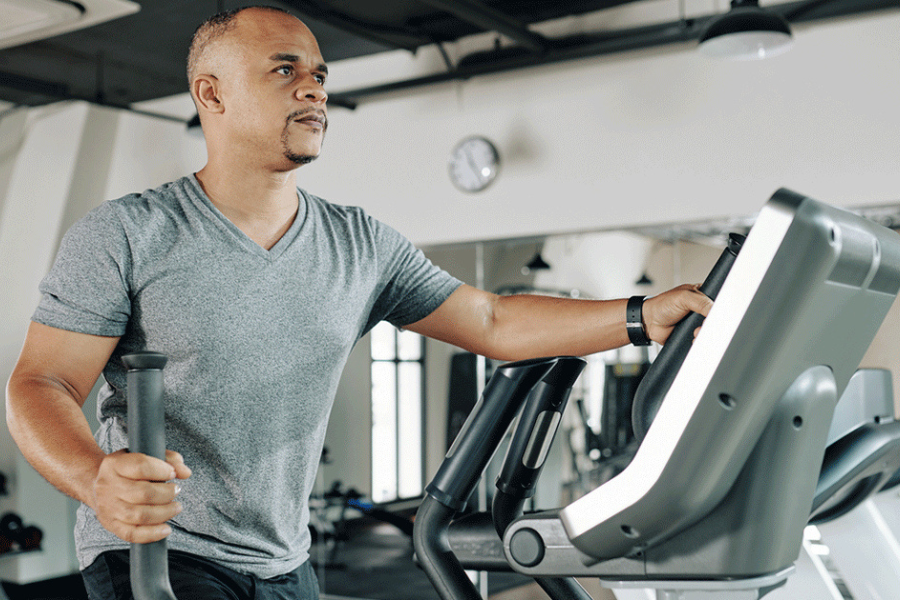
A high-intensity elliptical workout for men can do far more than just make you sweat. When you train with purpose, you can burn serious calories, build stamina, protect your joints, and get closer to your body composition goals in less time.
This guide walks you through how to use the elliptical for high-intensity interval training (HIIT), how to structure your workouts, and how to dial in your form so you actually see results.
Understand why the elliptical works
Before you jump into HIIT, it helps to know what the machine is actually doing for you. That way, every setting you touch has a clear goal behind it.
Full body training in one machine
Unlike some cardio equipment, an elliptical engages both your upper and lower body. With the handles and pedals working together, you recruit your:
- Glutes, hamstrings, quads, and calves
- Chest, back, biceps, and triceps
- Core muscles that stabilize your spine
This full body pattern means you can build strength and improve posture at the same time you work your heart and lungs. The moving arms and pedals make the elliptical a practical choice if you want to combine cardio with light strength training in one workout, according to physical therapist Corey Goldman of Harvard-affiliated Spaulding Rehabilitation, who notes that ellipticals provide a low impact, upper and lower body workout that is ideal when you want to protect your joints while training hard.
Low impact, high reward
If your knees, hips, or ankles complain when you run, the elliptical gives you a safer way to push your intensity. The pedals keep your feet in constant contact with the platform, which removes the pounding you get from each foot strike on the treadmill or pavement.
That is why elliptical training works well for:
- Men with knee pain or arthritis
- Anyone coming back from an injury or surgery
- Lifters who want tough cardio that does not interfere with joint recovery
Because the motion is smooth and low stress, you can still challenge your cardiovascular system without the same injury risk as high impact training.
Solid calorie burn in less time
Calorie burn always depends on your body size, intensity, and fitness level, but the elliptical holds its own.
- A 150 pound person doing a 30 minute moderate intensity elliptical workout will burn about 170 calories.
- A man around 185 pounds pushing at high intensity can burn roughly 400 calories in 30 minutes during an intense session.
Those numbers highlight why a high-intensity elliptical workout for men can be a strong tool for weight management and fat loss, especially if you are short on time.
Learn the basics of HIIT on the elliptical
High intensity interval training turns a standard cardio session into a focused performance workout. Instead of cruising at one pace, you alternate very hard efforts with easier recovery periods.
What HIIT on the elliptical looks like
On an elliptical, HIIT usually means you:
- Set resistance to a moderate to high level
- Drive the pedals and handles as fast as you can for a short burst
- Slow down and reduce resistance slightly for an active recovery window
- Repeat this pattern for a set amount of time
Common work to rest ratios include 30 seconds on and 15 seconds off, or 40 seconds on and 20 seconds off. Research shows that alternating very high intensity bouts with low intensity recovery makes your workout more time efficient than steady state cardio, while raising your metabolic rate and improving both aerobic and anaerobic capacity. That increase in effort can also create more excess post exercise oxygen consumption, or EPOC, so you continue to burn calories after your workout ends.
Health benefits beyond fat loss
The payoff from regular elliptical HIIT workouts is not only visible in the mirror. In a 12 week study of people with pre diabetes or type 2 diabetes who completed three elliptical HIIT sessions per week, participants saw lower fasting blood glucose, reduced waist and hip circumference, improved blood pressure, and better heart rate responses.
For you, this translates to:
- Better cardiovascular fitness
- Improved metabolic health markers
- Stronger heart and lungs
- Higher stamina in sports or daily life
If you are looking for a training style that gives both performance and health benefits, HIIT on the elliptical is worth the effort.
Set up your body and machine correctly
Good technique is what separates a productive high-intensity elliptical workout for men from a joint stressing slog. Spend a few minutes dialing in your body position and machine settings before you start hammering intervals.
Nail your posture and alignment
Proper form keeps you efficient and reduces injury risk. Focus on:
- Standing tall, not slouching over the console
- Pulling your shoulder blades gently together and down
- Making a slight “double chin” to keep your neck aligned
- Tucking your belly button lightly toward your spine to engage your core
- Keeping your feet centered on the pedals, heel and toe fully supported
- Holding the handlebars, not leaning your full weight on them
This posture helps you drive power from your hips and legs while your core stabilizes, which is exactly what you want during high intensity work.
Use resistance, incline, and direction wisely
The elliptical gives you several variables that you can use to target different muscles and adjust difficulty:
- Resistance: Higher resistance makes each stride harder and recruits more strength from your glutes, hamstrings, and quads.
- Incline or ramp height: A higher incline shifts more of the work into your glutes and hamstrings and prepares your body for outdoor hills.
- Direction: Pedaling forward hits the backside of the legs and glutes, while pedaling backward increases recruitment of the quadriceps and calves.
Alternating forward for 3 minutes and backward for 2 minutes is an effective way to vary muscle engagement and keep your workout mentally fresh.
Follow a beginner friendly HIIT elliptical plan
If you are new to high-intensity elliptical workouts, you do not need long sessions to see results. In fact, joint safe HIIT should stay relatively short.
Your first 23 minute HIIT session
Use this structure as a starting point:
- Warm up, 5 minutes at easy to moderate pace, low to moderate resistance.
- Work interval, 30 seconds at near maximal effort, fast pace, higher resistance.
- Recovery, 60 seconds very easy pace, lower resistance.
- Repeat steps 2 and 3 for 12 cycles.
- Cool down, 5 minutes easy pace, low resistance.
This gives you about 23 minutes total. As your fitness improves, you can shorten recovery to 45 seconds, or increase resistance slightly, while keeping total HIIT time under 20 minutes, which many trainers recommend for high intensity work.
Technique reminders during intervals
When the timer tells you to sprint, avoid the temptation to flail. Instead:
- Keep your posture tall and shoulders relaxed.
- Drive from your hips, not only your knees.
- Push and pull the handles with control so your upper body works too.
- Aim to breathe rhythmically, even when effort is high.
You are looking for “hard to very hard” exertion that you can sustain for the interval, not an all out effort that destroys your form.
Progress to advanced high-intensity workouts
Once a basic routine feels manageable, you can move into more challenging patterns that respect both intensity and safety.
Sample 30 minute advanced HIIT workout
Try this structure on days when you feel strong and rested:
- Warm up, 5 minutes at moderate pace and resistance.
- Intervals, 1 minute high intensity at a fast pace and high resistance, followed by 45 seconds of easy pedaling at lighter resistance.
- Repeat intervals for 18 to 20 minutes total.
- Cool down, 5 to 7 minutes at low resistance, gradually reducing speed.
Some advanced programs, such as a 10 minute elliptical HIIT workout described in a 2026 Garage Gym Reviews guide, use very short, maximum effort work periods with very easy rest and classify the session as hard to vigorous intensity, which can be effective when you are tight on time and want to train at the upper end of your capacity.
Mix incline and direction for leg development
To develop your lower body more fully, layer in incline and direction changes:
- Use higher incline settings for a few intervals to emphasize glutes and hamstrings.
- Drop the incline and pedal backward for quadriceps and calves focus.
- Return to a moderate incline and forward motion for balanced intervals.
You can rotate these patterns within one workout, for example, two forward intervals, one backward interval, repeated throughout the session.
Use elliptical HIIT alongside strength training
A high-intensity elliptical workout for men is a powerful tool, but it is not a complete training plan by itself, especially if strength and muscle gain are priorities.
What the research says about HIIT and muscle
A 2025 systematic review and meta analysis of 54 studies found that HIIT and sprint interval training may lead to slightly greater gains in fat free mass compared to moderate continuous training and non exercise controls, but the evidence quality was low and the confidence intervals crossed zero, which means the effect is not conclusive.
The same review reported that traditional resistance training is likely superior to HIIT or sprint intervals for improving leg press one repetition maximum strength. HIIT sessions usually produce lower peak forces, around 10 to 25 percent of one rep max, while strength work uses 30 to 90 percent of one rep max. This explains why HIIT is excellent for conditioning but not enough for maximal strength or muscle growth on its own.
How to combine HIIT and lifting
To get the best of both worlds:
- Prioritize resistance training on 2 to 4 days per week for major lifts such as squats, presses, rows, and deadlifts.
- Add 1 to 3 elliptical HIIT sessions per week on non lifting days or after shorter lifting sessions.
- Avoid doing maximal leg lifting and all out elliptical intervals back to back in the same workout multiple times per week, so your joints and nervous system can recover.
This mix lets you keep improving strength and muscle while using the elliptical to drive conditioning and fat loss.
Warm up, cool down, and recover smart
When the goal is intensity, it is tempting to skip the “boring” parts. That choice usually catches up with you in the form of tight hips, sore knees, or stalled progress.
Effective warm ups and cool downs
Use this simple framework around your sessions:
- Warm up: 5 minutes at a moderate speed and resistance to raise your heart rate and loosen your joints.
- Main set: Your planned HIIT intervals, staying under 20 minutes of true high intensity work.
- Cool down: 5 to 10 minutes at a slower pace and lighter resistance to gradually reduce heart rate and breathing.
For men who use the elliptical as part of a broader training plan, the same machine also works well for dynamic warm ups before lifting and longer cool downs after heavy sessions.
Signs you are doing it right
You know your high-intensity elliptical workout is on track when:
- You finish tired but not wrecked, and you can recover for your next session.
- Your breathing and heart rate spike during intervals but settle during recovery.
- Your form stays smooth, even when pace is fast.
- Over several weeks, resistance levels that once felt hard now feel manageable.
If you notice joint pain, dizziness, or chest discomfort, back off the intensity and consult a healthcare professional before continuing.
The goal is not to crush yourself in a single workout. It is to train consistently at a challenging level that your body can adapt to, week after week.
Start with the beginner routine, focus on posture and controlled intensity, and build up gradually. With a clear plan and smart progression, a high-intensity elliptical workout can become one of the most effective, joint friendly tools in your training toolkit.
About the Author