A strong chest does more than fill out your T‑shirt. The right chest routine helps you press heavier, protect your shoulders, and improve everyday movements like pushing a door or lifting a heavy box. If you are looking for good chest exercises for men that actually deliver serious gains, you will want a mix of heavy compound lifts and smart accessory work.
Below, you will find the best chest exercises, how to use them, and simple ways to build them into a weekly routine that matches your goals.
Understand how chest training works
Your chest is mainly made up of the pectoralis major and pectoralis minor. In simple terms, the pecs are responsible for bringing your arms across and in front of your body, as well as pressing away from you.
To build a bigger, stronger chest, you want to:
- Start your workout with heavy compound pressing movements
- Add isolation work to stretch and squeeze the pecs
- Use a mix of flat, incline, and bodyweight variations
- Train in the right rep ranges for your goal: roughly 1 to 6 for strength, 6 to 12 for muscle size, and 12 to 20 for endurance, as suggested in a June 2024 Gymshark chest workout guide
Aim for at least 10 sets of chest work per week spread across one or two sessions for solid progress, according to that same guide.
Build your base with pressing exercises
Pressing exercises are your main drivers of chest size and strength. They work multiple muscle groups at once, so you can use heavier loads and gain more overall power.
Barbell bench press
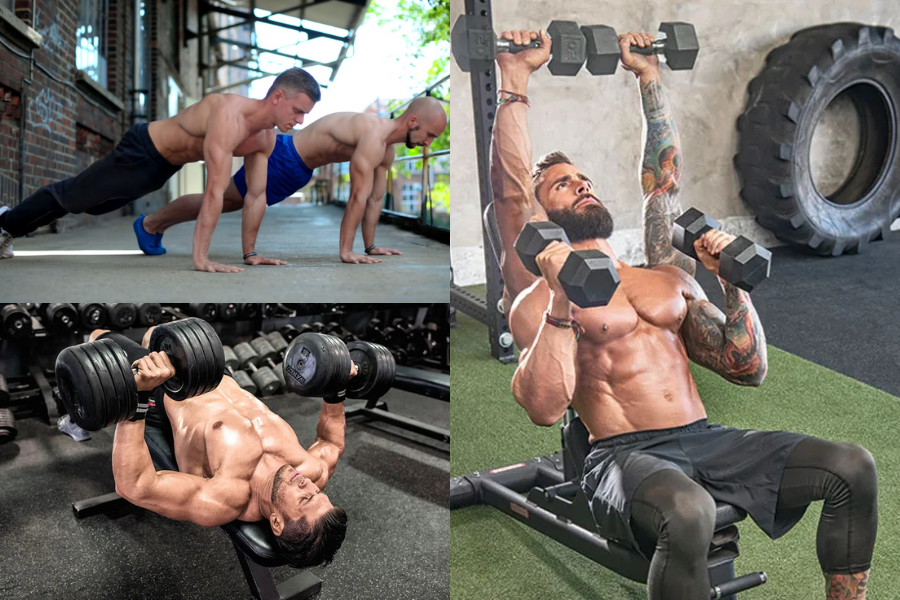
The barbell bench press is one of the best chest exercises for men when your goal is strength and mass. It primarily targets the inner chest, but it also recruits the rest of the pecs, the front of your shoulders, and your triceps, making it a full upper body push movement.
A guide updated in June 2024 recommends 3 to 4 sets of 8 to 10 reps for muscle growth with good form and controlled tempo. Focus on:
- Feet planted firmly on the floor
- Shoulder blades pulled back on the bench
- Bar path that touches around mid‑chest and finishes over your shoulders
This protects your shoulders and lets your pecs do most of the work.
Dumbbell bench press
The dumbbell chest press is a great alternative or companion to the bar. Because the weights move separately, you get more stability work and often more muscle activation in each side of your chest.
You can use similar set and rep ranges as the barbell bench, for example 3 to 4 sets of 8 to 10 reps. If one side of your chest is weaker, the dumbbells will quickly reveal it and help you correct the imbalance.
Floor press
If you train at home, or your shoulders feel cranky, the floor press is worth adding. You lie on the floor instead of a bench and press dumbbells or a bar. The limited range of motion reduces shoulder strain but still lets you load the chest and triceps hard.
Use 2 to 4 sets of 8 to 15 reps, focusing on a strong squeeze at the top without banging your elbows into the ground.
Target the upper chest with incline moves
A well developed upper chest gives your torso that squared, powerful look. The clavicular head of the pec is also harder to grow, so incline work matters.
Barbell incline bench press
The barbell incline bench press slightly elevates your torso, which shifts more work to the upper chest and front delts. Many lifters even rate it higher than flat bench for upper chest growth, and a 2013 Reddit discussion highlighted it as superior for that area.
Typical guidelines are 3 sets of 6 to 12 reps, starting light while you find a comfortable bench angle. Around 30 degrees is usually enough, too steep and it becomes more of a shoulder press than a chest exercise.
Dumbbell incline bench press
The incline dumbbell bench press offers a deeper stretch at the bottom and can be friendlier on your shoulders than the bar. Because each arm moves independently, it helps correct strength imbalances and forces you to control the weight.
The June 2024 Gymshark chest workout guide recommends 3 to 4 sets of 8 to 10 reps. Think about driving the dumbbells up and slightly together while keeping your chest lifted, not just locking out your elbows.
At‑home incline variations
If you do not have access to a bench, you can still target the upper chest and shoulders with incline style movements:
- Incline push‑ups with hands on a bench or chair, 3 to 4 sets of 8 to 15 reps, are easier than standard push‑ups and suit beginners
- Decline push‑ups with feet elevated increase the challenge and focus more on the upper chest and front shoulders, with 3 to 4 sets of roughly 5 to 15 reps
Keep your body in a straight line in both cases so your core stays engaged and your lower back does not sag.
Add isolation work to sculpt the chest
Once your heavy pressing is done, isolation exercises help you stretch and squeeze the pecs for extra growth and definition without overloading your joints.
Dumbbell flyes
Dumbbell chest flyes are a classic for a reason. You lie on a bench, open your arms in a wide arc, then bring the dumbbells together over your chest. The goal is not heavy weight, it is creating strong tension and a deep stretch.
Research in the brief suggests 3 sets of 10 to 12 reps with lighter weights. Move slowly, stop before your shoulders feel unstable at the bottom, and focus on hugging your arms around your ribcage rather than just moving your hands.
Cable and band flyes
Cable flyes keep constant tension throughout the movement, which many lifters say gives them the best chest definition. Resistance bands can work similarly if you are training at home.
You can perform them from a high, mid, or low anchor to emphasize different chest fibers. A common approach is 3 to 4 sets of 12 to 15 reps at the end of your session to finish the muscles without stressing your joints.
Single‑arm cable crossover
The single‑arm cable crossover adds a rotation component. You pull the handle across your body and slightly down, which works the inner and lower chest through the transverse plane. The June 2024 Gymshark article notes that this makes it a functional, athletic move with great mind‑muscle connection.
Because you are training one side at a time, you can really dial in technique. Keep the weight moderate and aim for 10 to 15 controlled reps per side.
Use bodyweight moves for size and strength
Bodyweight chest exercises are not just for beginners. Done correctly and progressed over time, they can rival weight training for muscle activation and strength.
Standard push‑ups
Push‑ups hit your chest, triceps, shoulders, and core. Studies involving young men with resistance training experience have shown similar strength gains compared to bench pressing when push‑ups are progressed properly, which was highlighted in the research you provided.
For beginners, 3 to 4 sets of around 10 to 15 reps works well. Keep your hands under your shoulders, your body in a straight line from neck to heels, and your core tight. If these are too hard, try incline push‑ups with your hands on a sturdy surface.
Push‑up variations
Once regular push‑ups feel easy, you can increase difficulty and target different areas of the chest with variations:
- Diamond push‑ups place your hands close together under your chest. These hit the inner chest, triceps, shoulders, and even your upper back. The research suggests 3 to 4 sets of 8 to 15 reps with short rest periods.
- Wide push‑ups emphasize the outer chest more and reduce triceps involvement.
- Offset and one‑leg push‑ups challenge your core and unilateral strength by shifting more load to one arm and leg at a time.
- Decline push‑ups, with feet raised, focus on upper pecs and front shoulders and are more intense than flat push‑ups.
- Deficit push‑ups, where your hands are on blocks or handles, increase the range of motion at the shoulders and elbows. As the research notes, this can boost chest hypertrophy by recruiting more motor units, but you need to be careful not to drop too deep and stress the shoulders.
Because advanced push‑ups can be demanding, you might use 3 sets of 6 to 8 reps for tough versions like deficit or plyometric push‑ups, and higher reps for easier variations.
Dips for lower chest
Bodyweight dips, especially when you lean forward slightly and let your elbows flare a bit, are excellent for targeting the lower chest. The June 2024 Gymshark article points out that they increase chest activation without overly fatiguing the triceps.
If standard dips are too hard, use an assisted dip machine or resistance band until you can handle your bodyweight. Once you can do sets of 10 to 12 clean reps, you can add weight with a belt or hold a dumbbell between your legs.
Put it together in a simple chest workout
You do not need a dozen exercises each session. You just need the right mix of compound lifts and focused accessories. Here is a sample gym workout that uses many of the good chest exercises for men covered above:
- Barbell bench press, 3 to 4 sets of 6 to 10 reps
- Incline dumbbell bench press, 3 sets of 8 to 10 reps
- Weighted dips or bodyweight dips, 3 sets of 8 to 12 reps
- Cable or dumbbell flyes, 3 sets of 10 to 15 reps
For a home‑based session, you could try:
- Push‑ups or incline push‑ups, 4 sets close to failure
- Decline push‑ups, 3 sets of 8 to 12 reps
- Deficit push‑ups, 3 sets of 6 to 8 reps
- Bench press with dumbbells or water bottles on the floor, 2 to 4 sets of 8 to 15 reps
Whichever plan you follow, keep rest periods around 60 to 120 seconds, longer for heavy barbell sets and shorter for isolation work.
Quick rule of thumb: start with your heaviest, most technical exercise, then move to moderate pressing, finish with isolation or higher rep bodyweight work.
Train smart for serious gains
Good chest exercises for men only deliver serious gains when you combine them with smart training habits. Three principles matter most:
- Proper form so your chest, not your joints, takes the load. Stick to controlled reps and ranges you can manage comfortably.
- Progressive overload by slowly increasing weight, reps, or sets over time. Even adding a rep or 2 per week makes a difference.
- Strong mind‑muscle connection, which means feeling the chest work and using smooth, deliberate movement, especially on flyes and push‑ups.
Aim for at least 10 total working sets of chest per week, as the June 2024 Gymshark guide recommends, and give yourself enough recovery between sessions. With consistency, you will notice not just a bigger chest, but better posture, stronger pressing power, and more confidence in and out of the gym.
About the Author