A strong, pain free back does more than fill out your T shirt. It supports every lift you do, protects your spine, and keeps you moving comfortably as you age. Good back exercises for men focus on strength, stability, and posture so you build muscle without wrecking your lower back in the process.
Below, you will find a simple guide to how your back works, the best movements to train it, and a sample workout you can follow whether your goal is size, strength, or staying out of the physical therapist’s office.
Understand why your back matters
Your back is part of your core, not separate from it. The muscles along your spine and around your shoulders help you:
- Stabilize your trunk when you lift, run, or twist
- Maintain good posture at your desk
- Protect spinal discs and ligaments during heavy loads
If you focus only on abs and skip your lower and upper back, you create imbalances that can lead to discomfort and injury later.
According to research summarized in The Physician and Sports Medicine, exercise is one of the most important self directed treatments for low back pain, which affects around 10 million people in England and Scotland alone, as referenced by Men’s Health UK in 2023. Regular, smart back training is one of the best investments you can make in your long term health.
Know the major back muscles you train
You do not need an anatomy textbook, but knowing the main players helps you choose smart exercises.
Your back includes:
- Latissimus dorsi (lats), the big muscles that give your torso a V shape
- Trapezius (traps), upper and mid back muscles that support your neck and shoulder blades
- Erector spinae, long muscles that run along your spine and help you stand tall and extend your back
- Smaller stabilizers like the multifidus and rotator cuff that keep the spine and shoulders in good alignment
- Rhomboids and rear deltoids, which pull your shoulder blades back and fight computer posture
The most effective way to train all of these is to combine vertical pulling exercises like pull ups with horizontal pulling like rows. When you add in a few targeted lower back and core moves, you cover the full picture.
Start with lower back stability and mobility
If your lower back is weak or stiff, loading it heavily too soon is a fast way to hurt yourself. Begin with bodyweight exercises that teach you to control your spine.
Bird dog
The bird dog builds baseline spinal stability and coordination.
How to do it:
- Start on hands and knees, wrists under shoulders and knees under hips.
- Brace your core lightly so your spine stays neutral.
- Extend your right arm forward and left leg back, reaching long without arching your back.
- Pause for a second, then return and switch sides.
Aim for 3 to 4 sets of 8 reps per side. Move slowly and keep your hips level. This exercise helps you resist rotation and prepares you for heavier lifts.
Cat stretch
The cat stretch improves mobility and relieves tension in the spine.
- Stay on hands and knees.
- Slowly round your back toward the ceiling, tucking your chin.
- Then gently sag your back, lifting your chest and tailbone.
Repeat this smooth motion 3 to 5 times, twice a day if you sit a lot. It is a simple way to keep your spine moving well.
Knee to chest and rotational stretches
These two floor stretches keep your low back and hips from getting locked up.
For knee to chest:
- Lie on your back with knees bent and feet flat.
- Pull one knee toward your chest with both hands.
- Gently tighten your belly and press your spine into the floor.
- Hold 5 seconds, then switch.
Repeat 2 to 3 times per leg, ideally twice a day.
For the lower back rotational stretch:
- Lie on your back with knees bent and feet flat.
- Keeping shoulders on the floor, roll both bent knees to one side.
- Hold 5 to 10 seconds, then move to the other side.
Repeat 2 to 3 times per side, twice daily. These stretches increase flexibility and help your back recover between workouts.
Build foundational lower back strength
Once your back moves well, you can add exercises that strengthen your spinal muscles and hips together.
Bridge
The bridge targets your glutes and lower back while teaching your core to support a neutral spine.
- Lie on your back with knees bent and feet hip width apart.
- Tighten your belly and squeeze your glutes.
- Push through your heels to lift your hips until your body forms a straight line from knees to shoulders.
- Take three deep breaths while holding the top, then lower slowly.
Start with 5 repetitions a day and build up to 30. You can later add weight by holding a dumbbell or plate across your hips.
45 degree extension
If you have access to a 45 degree back extension bench, this move is excellent for your erector spinae and hips.
- Set the pad so your hips can bend freely.
- Cross your arms or hold a light weight to your chest.
- Lower your torso until you feel a stretch in your hamstrings.
- Raise your torso by squeezing your glutes and lower back until your body is in a straight line, not hyperextended.
Perform 3 to 4 sets of 15 controlled reps. Focus on smooth movement and avoid rounding your spine at the bottom to reduce strain.
Romanian deadlift
The Romanian deadlift (RDL) is one of the best lifts for building strong hamstrings, glutes, and lower back under load.
- Stand tall holding a barbell or dumbbells in front of your thighs.
- Soften your knees slightly.
- Push your hips back while keeping your chest lifted and spine neutral.
- Slide the weight down your legs until you feel a strong stretch in your hamstrings.
- Pause briefly in that hinged position.
- Drive your hips forward to return to standing.
Aim for 3 to 4 sets of 8 to 12 reps. Use a weight that challenges you while still allowing perfect form. The goal is to feel tension in your hamstrings and glutes, not pain in your lower back.
Strengthen the deep core to support your back
Your core works as a 360 degree cylinder around your spine. These exercises help your obliques and deep abdominal muscles share the workload with your back.
Side plank
Side planks target the muscles along your sides and glutes that keep your spine from collapsing into bad posture.
- Lie on your side, elbow under shoulder and legs straight.
- Stack your feet or place one in front of the other.
- Lift your hips so your body forms a straight line from head to feet.
- Keep your head in line with your spine and do not let your hips sag.
Work up to 2 to 3 sets per side of 40 seconds. If this is too challenging, bend your bottom knee and keep that leg on the floor as a support.
High plank
A high plank looks like the top of a push up but it hits your shoulders, core, and back together.
- Place your hands under your shoulders and step your feet back.
- Brace your core, squeeze your glutes, and keep your body in a straight line.
- Avoid letting your lower back sag.
Hold for time or combine with movements like shoulder taps. This simple position builds the endurance needed for good posture.
Train your upper back for posture and size
Upper back work is where a lot of the visible muscle comes from. It also fights the rounded shoulders that show up after years of computer use.
Conventional deadlift
The conventional deadlift is a full body movement that works everything from your calves to your upper traps. It is also one of the best overall back builders when done correctly.
- Stand with your mid foot under the bar.
- Hinge at your hips and bend your knees until your shins touch the bar.
- Grip the bar just outside your knees.
- Set your back in a neutral position by lifting your chest and bracing your core.
- Push the floor away, extending your hips and knees at the same time.
- Stand tall with the bar close to your body, then reverse the motion under control.
Because deadlifts load your entire posterior chain, start with submaximal sets as a warm up. As you get stronger, you can build up to heavier sets to drive muscle growth and strength, especially in your hamstrings, glutes, and upper back.
Bent over row and Pendlay row
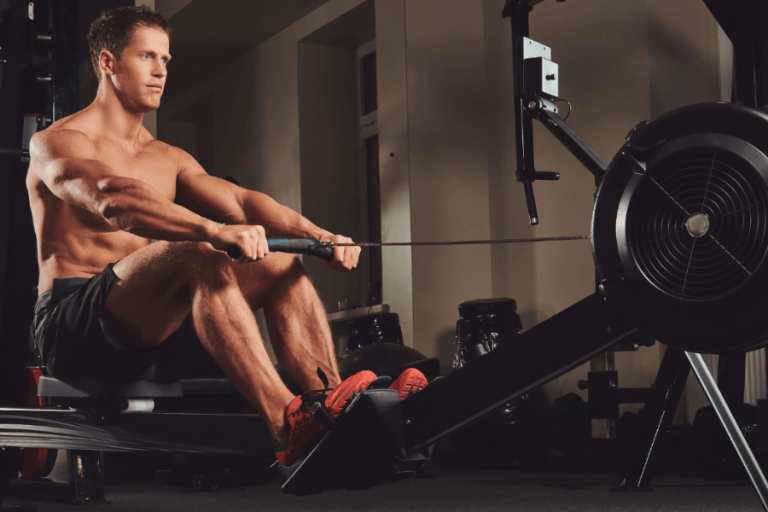
Rows are essential horizontal pulling movements that build thickness through your mid and upper back.
For the bent over barbell row:
- Hinge from your hips with a soft bend in your knees.
- Keep your spine neutral and torso roughly 45 degrees to the floor.
- Pull the bar toward your lower ribs, squeezing your shoulder blades together.
- Lower under control without letting your back round.
This variation works your rhomboids, rear delts, traps, and lats while your core and legs stabilize you.
The Pendlay row starts similarly but the bar returns to the floor each rep and your torso stays closer to parallel with the ground. You pull explosively from a dead stop, which limits momentum and can improve power and athleticism. Use an overhand grip about shoulder width and reset your spine before every pull.
Single arm dumbbell row
Single arm rows let you train each side independently, which helps correct imbalances and reduce stress on your lower back.
- Place one knee and the same side hand on a bench.
- Hold a dumbbell in the other hand with your arm extended toward the floor.
- Keep your back flat, then row the weight toward your hip.
- Squeeze at the top and lower with control.
Perform 8 to 12 or more reps per side. As you get stronger, you can try an RNT (reactive neuromuscular training) variation by attaching a resistance band to the dumbbell to increase lat engagement through a slight arc toward your hip.
Pull ups and grip variations
Pull ups are often called the king of back exercises for men. They target your lats, biceps, rhomboids, delts, traps, and more while building serious upper body strength and a V shaped torso.
Start with an overhand grip just wider than shoulder width. If you cannot yet do full pull ups, use resistance bands, ring rows, or lat pulldowns as progressions. Over time, use different grips:
- Underhand weighted chin ups to emphasize biceps and lower lats
- Overhand wide grip pull ups to hit upper lats and teres major
- Neutral grip variations for a comfortable wrist position and fuller range of motion
These changes help you cover all areas of your back and avoid overuse in any single movement pattern.
Band pull aparts and shoulder blade squeezes
You do not always need heavy weight to improve posture. Light exercises done often can make a big difference.
Band pull aparts with a supinated grip (palms up) are great for the upper back and rotator cuff. Use enough band tension so you can complete 15 to 25 reps with good form. Focus on pulling your shoulder blades together instead of shrugging your shoulders up.
The shoulder blade squeeze is even simpler:
- Sit upright on an armless chair.
- Pull your shoulder blades toward each other.
- Hold for 5 seconds, then relax.
Repeat 3 to 5 times, twice a day. These small sessions help counteract slumping and support long term shoulder health.
Add posture friendly movements and recovery
Beyond lifting, a few other practices support a strong, pain free back.
Downward Facing Dog is a yoga pose that lengthens your hamstrings and calves while strengthening and aligning your back muscles. High planks, side planks, and glute bridges all help you maintain better posture in daily life by building strength through your core and hips.
Foam rolling your upper back after intense workouts or long days at a desk can reduce muscle tightness and soreness. Fitness experts such as Paige Waehner in a 2023 Verywell Fit guide recommend it as a recovery tool to help maintain flexibility and comfort after training.
Put it together in a simple back workout
Here is a sample routine that combines good back exercises for men into a balanced session. Adjust sets and reps to your current level.
- Warm up
- 3 to 5 minutes of light cardio
- Cat stretch, knee to chest, and rotational stretches
- Activation
- Bird dog, 3 sets of 8 reps per side
- Side plank, 2 sets per side of 20 to 40 seconds
- Main lifts
- Conventional deadlift, 3 to 4 sets of 5 to 8 reps
- Pull ups or band assisted pull ups, 3 to 4 sets to near technical failure
- Accessory work
- Bent over rows or Pendlay rows, 3 sets of 8 to 10 reps
- Single arm dumbbell rows, 3 sets of 10 to 12 reps per side
- Band pull aparts, 2 sets of 15 to 20 reps
- Finisher and cool down
- Bridge, 2 sets of 10 to 15 reps
- 45 degree extensions if available, 2 to 3 sets of 12 to 15 reps
- Light stretching and a few minutes of foam rolling
You can run this workout once or twice per week, leaving at least a day of rest between heavy back sessions. Over time, add weight, reps, or an extra set when the routine starts to feel comfortable.
When to be cautious or get help
If you already have back pain, especially sharp, shooting, or long lasting pain, talk with a healthcare professional before you add heavy exercises. Many low back issues improve with smart training, but some conditions require specific guidance.
Listen to your body. Muscle fatigue and mild soreness are normal. Sudden pain, loss of feeling, or discomfort that worsens with every session are signs to back off and get assessed.
The goal is not just a bigger back. It is a stronger, more capable body that lets you lift, work, and live without being limited by pain. Start with a few of these exercises today, focus on clean form, and build up gradually. Over the coming weeks, you will feel the difference every time you sit, stand, and pick something up.
About the Author