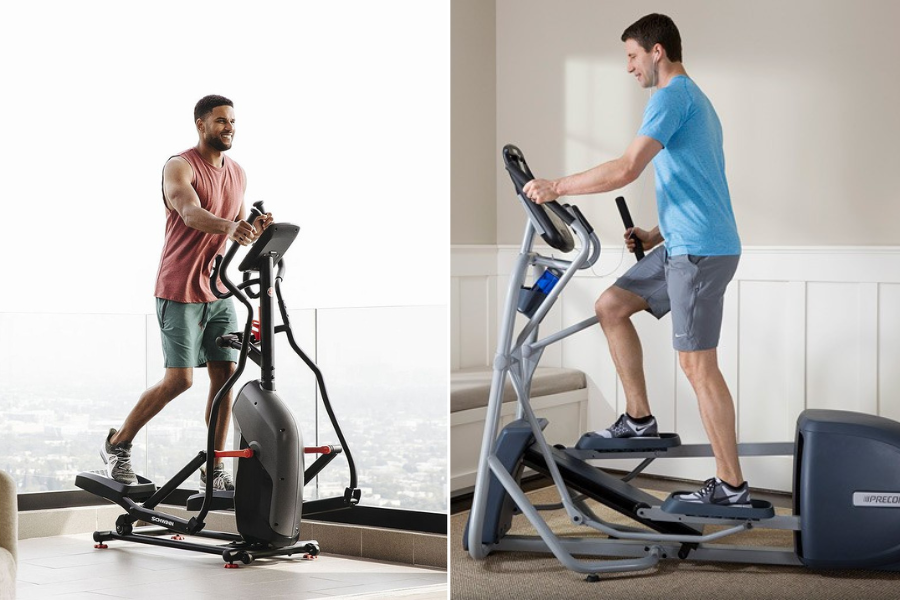
A well planned elliptical workout for men can do more than just make you sweat. When you use the machine correctly, you train your heart, build muscle, protect your joints, and burn serious calories in a relatively short time.
Below, you will learn how to set up your elliptical sessions for strength, fat loss, and stamina, along with sample routines you can start this week.
Why the elliptical is a smart choice for men
Elliptical machines give you a low impact, full body cardio workout that is easier on your joints than running. Your feet stay on the pedals instead of pounding the ground, which helps reduce stress on your knees, hips, and ankles compared to jogging or high impact classes, according to Harvard Health Publishing in 2023.
Because many ellipticals have moving handles, you work your upper and lower body at the same time. When you coordinate your arm and leg movements, you can engage your:
- Glutes
- Hamstrings
- Quads
- Calves
- Chest
- Back
- Biceps and triceps
- Core muscles
This combination of cardio and resistance can help you improve your cardiovascular fitness, build muscle endurance, and support better posture.
Calorie burn and fat loss potential
If your main goal is fat loss or weight management, the elliptical can be a powerful tool when you use it consistently and pair it with solid nutrition.
Men weighing between 125 and 185 pounds can burn roughly 270 to 400 calories in 30 minutes on an elliptical at moderate to vigorous intensity, depending on speed, resistance, and incline. Another estimate suggests that a 155 pound person can burn about 324 calories and a 185 pound person about 378 calories during 30 minutes at a moderate pace.
The U.S. Department of Health and Human Services recommends that you aim for 150 to 300 minutes of moderate intensity or 75 to 150 minutes of vigorous intensity aerobic exercise each week. You can meet these guidelines entirely with an elliptical if you prefer, even in short 15 to 30 minute sessions.
For fat loss, you will get more from your elliptical workout for men when you:
- Mix steady state sessions with high intensity interval training (HIIT), which research suggests is more effective at reducing body fat percentage and abdominal fat than steady cardio alone
- Maintain a calorie deficit with a diet focused on fruits, vegetables, lean proteins, and whole grains
- Support recovery with 7 to 8 hours of sleep and good stress management, since exercise alone is often not enough if your lifestyle keeps you in a calorie surplus
Think of the machine as a tool. The right workout structure plus a reasonable diet is what actually moves the scale.
Muscles you train on the elliptical
Although the elliptical is often labeled as a cardio machine, you can absolutely use it to challenge your muscles.
When you keep your hands on the moving handles, you target:
- Upper body: biceps, triceps, shoulders, chest, and upper back
- Core: deep spinal muscles such as the erector spinae and larger muscles like the latissimus dorsi that help you stabilize your torso
- Lower body: glutes, hamstrings, quads, calves, and even the small muscles in your feet
You can emphasize different areas by adjusting a few settings and how you move:
- Increase resistance to mimic climbing and boost strength in your legs and glutes
- Raise the incline to target glutes, hamstrings, and calves
- Pedal forward to hit hamstrings and glutes harder
- Pedal backward to shift more work to quads and front thighs
- Slightly bend your knees into a half squat to burn out your quads and glutes
This is why the elliptical can be especially useful if you want joint friendly conditioning that also supports muscle building.
Form basics to stay safe and get more from each session
Good form lets you train harder with less injury risk. As you dial in your elliptical workout for men, pay attention to:
- Posture: Stand tall, keep your chest open, and avoid leaning heavily on the handles. Think of your head stacked over your hips.
- Hand position: Keep both hands on the handles during most of the workout. You can let go briefly in warm up, cool down, or low intensity periods to challenge your core and balance.
- Foot placement: Center each foot on the pedal, with even pressure through the whole foot. This helps protect your knees and ankles.
- Range of motion: Use a comfortable, full stride. Do not lock your knees at the bottom of the movement.
Wear supportive running shoes or cross trainers with good arch support, stability, and cushioning. These help keep your feet comfortable and reduce your chance of overuse aches during longer sessions.
Beginner friendly 20 minute elliptical workout
If you are new to the elliptical or coming back after a break, start with a simple 20 minute plan at low to moderate intensity. Your goal here is to build the habit and learn the feel of the machine.
- Warm up, 5 minutes
- Light resistance, low incline
- Comfortable pace where you can talk easily
- Main set, 12 minutes
- Increase resistance slightly to a level that feels like a 6 out of 10 effort
- Maintain a steady, smooth pace
- Keep your hands on the handles and focus on matching your arm and leg movements
- Cool down, 3 minutes
- Drop resistance back to your warm up level
- Gradually slow your stride
You should finish feeling like you worked, but not like you had nothing left. Stay at this level two to three times per week for a couple of weeks, then begin to add time or resistance.
10 minute HIIT elliptical workout when you are short on time
On busy days, a high intensity interval training session gives you a lot of benefit in a small window. A 10 minute HIIT workout can be a hard to vigorous intensity session that boosts your conditioning and burns plenty of calories in less time.
Try this structure:
- Warm up, 2 minutes
- Easy pace and low resistance
- Intervals, 6 minutes total
- 30 seconds at near maximum effort, push the pace and increase resistance
- 30 seconds very easy, reduce resistance and slow down
- Repeat this 6 times
- Cool down, 2 minutes
- Return to low resistance and slow pace
Because these intervals are intense, keep your posture upright and focus on controlled breathing. Use HIIT sessions 1 to 3 times per week and avoid doing them on back to back days so your legs and joints recover.
30 minute fat burning interval workout
When you have more time, you can combine intervals and steady work to create a highly effective fat loss session that is still friendly to your joints.
Use this 30 minute format:
- Warm up, 5 minutes
- Low resistance, easy pace
- Interval block, 10 minutes
- 1 minute hard effort at higher resistance, about 7 to 8 out of 10
- 1 minute moderate recovery, drop resistance slightly but keep moving
- Repeat 5 times
- Steady climb, 10 minutes
- Set a moderate pace you can sustain
- Every 2 minutes, bump either resistance or incline up a notch
- Aim to finish breathing heavily but in control
- Cool down, 5 minutes
- Gradually dial resistance back down and slow your stride
If you are using the elliptical 4 or 5 days per week, you might make this your main fat burning workout twice weekly, with lighter steady sessions on other days.
Upper body focused elliptical workout
If you want more arm and upper body challenge, you can structure your elliptical workout for men to put the emphasis above the waist.
Try a 20 minute upper body session:
- Warm up, 4 minutes
- Light resistance for both arms and legs
- Upper body block, 12 minutes
- Increase resistance enough that your arms feel most of the work, but not so much that your legs grind to a halt
- Push and pull the handles with control, keep your elbows slightly bent
- Keep your lower body at a smooth, moderate pace
- Finisher, 2 minutes
- Short burst at higher resistance, drive the handles as if you are doing standing rows and chest presses
- Cool down, 2 minutes
- Ease resistance down and let your pace slow
This type of session will not replace heavy lifting, but it can add valuable volume for your shoulders, back, chest, and arms, especially on days when you do not have time for a full strength workout.
Weekly schedule ideas for different goals
To hit general health guidelines and make steady progress, you can build a weekly schedule around your main goal. Here are a few sample approaches:
-
For overall health and weight maintenance
-
3 days per week, 30 minutes of moderate steady state
-
1 day per week, 20 minute beginner intervals
-
For fat loss
-
2 days per week, 30 minute fat burning interval workout
-
2 days per week, 30 to 45 minutes moderate steady state
-
Strength training 2 days per week to support muscle and metabolism
-
For conditioning and performance
-
1 day per week, 10 minute HIIT session plus extra easy pedaling
-
2 days per week, 30 minute interval sessions
-
1 or 2 days per week, 45 to 60 minutes at moderate pace
You can adjust the resistance and incline over time so that what once felt hard becomes your new normal.
If a workout feels too easy for a week or two in a row, increase either resistance, incline, or duration slightly so you keep challenging your body.
Final tips to keep progressing
To get the most from your elliptical workout for men:
- Track your settings and time so you can see progress
- Mix forward and backward pedaling to train different muscle groups
- Use the machine’s hill or interval programs to change intensity automatically
- Start conservatively if you have joint issues, and talk with your doctor if you have knee or hip arthritis before making big jumps in intensity
- Combine elliptical training with a balanced diet, strength work, and quality sleep
With a clear plan and a bit of consistency, your elliptical can become one of the most efficient tools in your routine for building endurance, protecting your joints, and driving steady fat loss.
About the Author