A strong core does more than help you see abs in the mirror. It supports your spine, powers your lifts, and keeps you steady in everyday movements. The good news is that you can build it with effective ab workouts at home, and you do not need any equipment to get started.
Below, you will learn how your abs actually work, the best bodyweight exercises to target them, and how to put everything into a simple routine you can follow in your living room.
Understand your core muscles
When you think of abs, you probably picture a six pack. In reality, your abdominal muscles are a group of four main muscle areas that work together to move and stabilize your torso. A solid ab workout should train all of them, not just the front.
You have the rectus abdominis, which runs down the front of your midsection and is responsible for that six pack look. Then there are the obliques on the sides of your waist, which handle rotation and side bending. Deeper underneath, the transverse abdominis and other stabilizers act like a weightlifting belt for your spine, keeping everything braced when you lift, run, or change direction.
When you aim for effective ab workouts at home without equipment, your goal is to train these muscles in different directions. That means including exercises that flex your spine, resist rotation, rotate your torso, and hold your body steady in a plank position.
Why visible abs start in the kitchen
You can train your core hard and still not see definition if there is a layer of body fat covering the muscles. Fitness editor and elite trainer Andrew Tracey highlights that getting a six pack is more about reducing stored body fat than endlessly adding more crunches to your workouts, which means your nutrition and lifestyle matter just as much as your training as of June 2024.
For most men, that means creating a mild calorie deficit, getting enough protein, and keeping your meals based on whole foods. This approach helps you gradually lower your body fat so the muscle you are building underneath becomes visible. It is not about crash diets. It is about a way of eating you can keep up while still training with energy.
Think of your ab training and your nutrition as a partnership. You build the muscle with smart, consistent workouts. You reveal it by managing calories and choosing mostly lean proteins, vegetables, whole grains, and healthy fats.
Core principles of effective home ab training
Before jumping into specific moves, it helps to know the basic rules that make your at home ab workouts actually work.
You want to train your abs two or three times per week. More is not always better. Your abs recover quicker than some larger muscles, but they still need at least 24 hours of rest after a full session to repair and grow. Overdoing ab work every day can leave you sore without extra benefit.
Try to build each session around three to five core exercises. Aim for 10 to 15 controlled reps per exercise and perform two or three sets, depending on your time and energy. You can also use timed holds for moves like planks or side planks, typically 20 to 40 seconds per set.
Progressive overload is key. Elite trainers emphasize that to actually build muscle in your midsection, you should gradually make things harder. At home, you can do this by slowing down your reps, adding more sets or reps, pausing at the hardest point of the movement, or eventually holding a small weight.
Five essential no equipment ab exercises
These bodyweight movements give you a balanced, effective ab workout at home using only your body and a bit of floor space. Each one targets your core in a slightly different way.
1. Bicycle crunch
The bicycle crunch is a staple for a reason. The American Council on Exercise ranked it as one of the most effective ab exercises for engaging your obliques and deeper core muscles through controlled rotation as of December 2019. It requires no equipment and is easy to scale up or down.
Lie on your back with your hands lightly behind your head and your knees bent. Lift your shoulders off the floor, brace your core, and bring your right elbow toward your left knee while extending your right leg. Then switch sides in a pedaling motion, focusing on slow, deliberate twists rather than speed.
Aim for 10 to 20 total reps at first. If you feel your neck straining, reduce your range of motion and keep your chin slightly tucked, as if holding an orange under your chin.
2. Bird dog
If you deal with a tight or achy lower back, the bird dog deserves a place in your routine. It strengthens your rectus abdominis and obliques while also improving lower back function. Because you are on all fours, it trains your core and back together, which can help reduce discomfort over time.
Start on your hands and knees with your wrists under your shoulders and your knees under your hips. Brace your core so your spine stays neutral. Extend your right arm forward and your left leg back until they are in line with your torso, pause, then return to the start and switch sides.
Keep your hips level and avoid arching your lower back. Move slowly and think more about control than height. Try 8 to 12 reps per side.
3. Leg raise
Leg raises hit the lower portion of your abs and your hip flexors, which play a huge role in powerful squats, running, and jumping. Performed with a controlled tempo, they can be challenging even without any added weight.
Lie on your back with your legs straight and your hands beside you or under your hips for support. Brace your core, press your lower back gently toward the floor, and lift your legs together until they are roughly vertical. Pause briefly, then lower them under control until your feet are just above the ground, and repeat.
For maximum effect, you can follow a 3 1 2 0 tempo. Take three seconds to raise your legs, pause for one second at the top, lower for two seconds, and do not rest at the bottom. If your lower back arches or feels strained, limit how far down you lower your legs or bend your knees slightly.
4. Side plank
The side plank is a powerful isometric move, which means you are holding a position rather than moving through reps. It targets your obliques and deeper stabilizers and also challenges your glutes and shoulder. Over time, it can improve posture and help protect your spine from bending too far to the side.
Lie on your side, then prop yourself up on your forearm with your elbow under your shoulder. Stack your feet, lift your hips so your body forms a straight line from your head to your heels, and keep your core engaged. Hold the position without letting your hips sag.
If this is too difficult, you can bend your knees and keep them on the floor, or reduce the hold time. Aim for 15 to 30 seconds per side and build up as you get stronger.
5. Classic crunch and reverse crunch
Despite a lot of new gadgets and trendy movements, classic crunches still show some of the greatest abdominal muscle activation compared to many equipment based options. When paired with reverse crunches, they give your upper and lower abs a simple, effective challenge.
For a standard crunch, lie on your back with your knees bent and feet flat on the floor. Place your hands lightly behind your head, exhale, brace your core, and curl your shoulders off the ground, focusing on bringing your ribcage toward your pelvis. Lower under control and repeat.
For the reverse crunch, bring your knees up to 90 degrees so they are above your hips. Use your abs to curl your hips off the floor and bring your knees slightly toward your chest, then slowly lower your hips back down. Move in a small, controlled range and avoid swinging your legs.
A simple 10 minute no equipment ab circuit
To turn these exercises into a quick routine, you can use a circuit. Circuits are time efficient because you move from one exercise to the next with minimal rest, which keeps your core under tension and your heart rate slightly elevated.
Here is a sample 10 minute ab circuit you can try at home:
- Bicycle crunch, 30 seconds
- Bird dog, 30 seconds
- Leg raise, 30 seconds
- Side plank, 30 seconds on the right
- Side plank, 30 seconds on the left
- Crunch, 30 seconds
- Reverse crunch, 30 seconds
- Mountain climber twist, 30 seconds
- Plank up, 30 seconds
- Rest, 30 to 60 seconds
Repeat the circuit twice. This layout mirrors the idea behind popular 10 minute no equipment ab workouts that use 10 moves for 30 seconds each and then repeat the full round. You can rest briefly as needed, but try to keep your breaks controlled so the session still feels like a focused block of core work.
If you are a beginner, you can start with just one round. Over time, you can shorten your rest, add a third round, or increase each interval from 30 to 40 seconds.
If you can stick to a short, focused routine like this two or three times a week, results will come from consistency rather than marathon sessions.
Progressing your ab workouts over time
As your core becomes stronger, you do not want to perform the same easy set of crunches forever. To keep improving, you should apply progressive overload, which simply means asking a little more from your muscles over time.
You can do that in a few different ways at home. Add more reps or sets for your key exercises. Slow down your tempo to increase tension and reduce momentum. Add short pauses at the hardest part of the movement, such as holding your legs inches above the floor at the bottom of a leg raise.
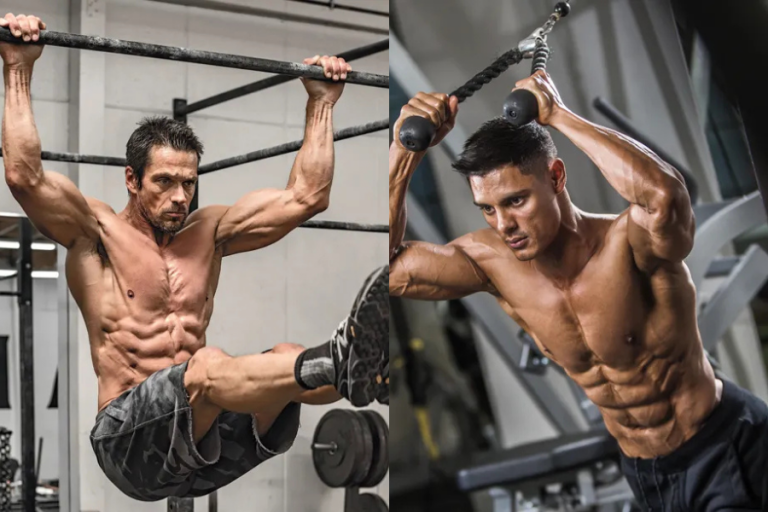
You can also upgrade basic moves with harder variations. For example, the Spiderman press up takes a standard push up and makes it a serious core challenge by reducing your points of contact to three and forcing your abs to stabilize each rep. Hanging leg raises are another advanced option if you have a pull up bar at home, and variations like twisting knee raises can keep your routine from feeling stale.
The important thing is to track what you do, even if it is just a note in your phone. If you did two sets of 12 bicycle crunches this week, aim for two sets of 14 or three sets of 10 next week.
Balancing training, recovery, and lifestyle
Your abs work in almost every compound lift and athletic movement, and they also take stress from your day to day posture. Because of that, you want to train them hard, but you also need to recover.
Give your abs at least one day off after a focused ab workout. Use that time for walking, light stretching, or other training that does not directly hammer your core. Most people do well with two or three ab sessions per week, each lasting between 5 and 30 minutes depending on intensity and experience.
Sleep supports muscle repair as much as your workouts do. Aim for 7 to 8 hours per night so your body has time to rebuild. Combine that with a balanced diet rich in fiber, protein, and healthy fats to help lower body fat and make your abdominal muscles more visible.
When you put it all together, effective ab workouts at home are about smart exercise selection, gradual progression, and everyday habits that support your results. Start with the simple circuit above, stay patient, and let your effort compound week after week.
About the Author