A strong, well balanced chest does a lot more than fill out a T shirt. The right chest routine for men can improve posture, protect your shoulders, boost your pressing strength, and support healthy weight management, since your pecs are large muscles that burn plenty of energy when you train them.
You do not need an advanced program to see results. You do need a simple plan that covers all areas of the chest, uses safe form, and fits your current level. The steps below walk you through how to build that kind of routine, whether you train at home, in a gym, or both.
Understand your chest muscles
Before you decide which exercises to use, it helps to know what you are actually trying to train.
Your chest is made up mostly of two muscles:
- Pectoralis major. This is the large, fan shaped muscle across the front of your chest. It has upper, middle, and lower fibers and it controls most pushing and hugging movements, like pressing a barbell, doing a push up, or bringing your arms across your body.
- Pectoralis minor. This is a smaller muscle that sits under the pec major. It helps move and stabilize your shoulder blade.
These muscles assist with pushing, pulling, rotating, and lifting. Since they are large, training them can help you burn significant energy and can contribute to fat loss when combined with solid nutrition and overall activity.
A smart chest routine for men should target the upper, middle, and lower portions of the pecs and should also respect your shoulders and elbows so you can train consistently.
Choose the right training frequency
You do not need to hammer your chest every day to see growth. In fact, that can slow your progress.
Most men do best with 1 to 3 chest focused sessions per week, depending on experience and recovery capacity.
- Beginners. Once or twice per week as part of a full body or upper body split is usually enough. This gives your joints time to adapt while you learn form.
- Intermediate and advanced lifters. Two focused chest sessions per week often works well. One can be heavier and strength focused, the other lighter and higher rep for extra volume.
Aim for at least 10 quality sets per week that target your chest if your main goal is size and strength. That might look like 5 sets on two days or 3 to 4 sets on three days, spread across different exercises.
Start every workout with a warm up
Cold, stiff muscles do not perform well and they are easier to injure. A good warm up prepares your chest and shoulders so you can train harder and more safely.
Spend 5 to 10 minutes on:
- General movement. A light jog, brisk walk, or a few minutes on a bike or rower.
- Dynamic upper body moves. Arm circles, band pull aparts, and wall slides.
- Easy warm up sets. Use the movement you plan to train, such as push ups or light bench press, for 1 or 2 sets with very easy effort.
Properly warming up your chest muscles reduces the risk of sprains, strains, or tears and improves your range of motion, so you can get more from each rep.
Quick rule: your first working set should never be the first time that day you move a weight through that motion.
Learn form fundamentals that protect your shoulders
Many men feel chest exercises in their shoulders more than their pecs. This usually comes down to technique.
A few key form cues make a big difference:
Set your shoulder blades
Before each press or push up, gently pull your shoulder blades together and down toward your back pockets. This is called scapular retraction.
Retracting and “grounding” your shoulder blades on the bench or floor:
- Reduces overuse of your shoulders and front delts
- Helps you keep a stable base
- Lets your pecs do more of the work
This is especially important for barbell and dumbbell presses.
Use joint friendly elbow angles
A common mistake is flaring your elbows straight out to the side at 90 degrees. This puts extra stress on your shoulders.
For most men, a 45 degree angle between the upper arm and your torso is safer and more powerful. You will feel:
- Less pinching in the front of the shoulder
- Better engagement in the chest and lats
- More control at the bottom of the rep
Men’s Health fitness director Ebenezer Samuel points out that this adjustment alone can reduce shoulder discomfort in the dumbbell bench press and help you press more over time.
Press in the right direction on incline work
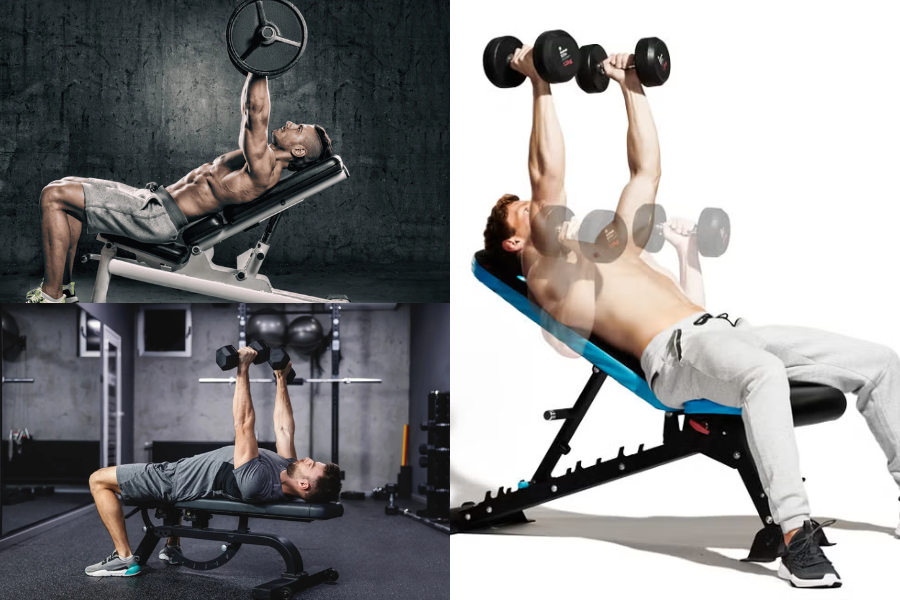
When you use an incline bench to hit your upper chest, keep your forearms vertical, perpendicular to the ground, at the bottom and top of each rep.
If you press the weights straight over your face or with your torso at a steep 90 degree angle, you load your shoulders more than your pecs and increase the chance of strain. A moderate 30 to 45 degree incline is usually enough to target the upper chest without beating up your joints.
Pick exercises that cover the whole chest
The “perfect” chest routine for men is rarely built on one exercise. You want a mix that covers:
- Heavy presses for overall mass and strength
- Isolation work that emphasizes adduction, or bringing your arms across your body
- Different angles, so you do not overdevelop only one area
Core compound moves
These are your main strength builders:
- Barbell bench press. One of the best chest exercises for men. It primarily targets the inner and mid chest and it also recruits the front deltoid and triceps. You can usually move more weight here than with dumbbells because both arms work together under one bar.
- Incline dumbbell bench press. Great for the upper chest, or clavicular head. Using an incline between 30 and 45 degrees increases stretch at the top of your chest and lets your arms move more freely than a barbell.
- Dips. When you lean your torso forward and allow a small amount of elbow flare, dips become a powerful lower chest builder. You can start with bodyweight and later add a belt or hold a dumbbell between your legs.
Isolation and adduction moves
Classic bench press variations do not take your arms all the way across your midline, which is where your chest contracts hardest. That is why adduction focused moves help complete your routine.
Good options include:
- Cable crossovers. Adjust the pulley height to change the focus. High to low for lower chest, low to high for upper chest, and mid height for mid chest. Aim to bring your hands slightly past the midline and squeeze at the end.
- Dumbbell flyes. Performed on a flat or incline bench. Keep a soft bend in your elbows and focus on hugging the weight up and in rather than dropping into an extreme stretch.
Push up variations
Push ups are more than a beginner move. With the right tweaks, they can challenge any level and are ideal for at home training.
Useful variations include:
- Regular push ups
- Incline push ups, hands elevated, for beginners or higher reps
- Decline push ups, feet elevated, for more upper chest and difficulty
- Wide grip push ups for more chest involvement
- Diamond push ups for inner chest and triceps
- Plyometric or “clap” push ups for power
An effective no equipment chest routine for men might combine 10 regular push ups, 10 incline push ups, 10 decline push ups, and 5 slow, time under tension push ups, repeated for three rounds with cardio moves like star jumps and mountain climbers in between sets.
Use a simple weekly structure
Once you have your exercise menu, turn it into a clear plan. Here is an example of a straightforward two day chest routine for men that trains all areas of the chest and fits within 30 to 60 minutes.
Day 1: Strength and overload
Focus on heavier sets with longer rests.
- Barbell bench press
- 4 sets of 6 to 10 reps
- Pair each set with 15 reps of horizontal cable crossovers as a drop set, with little to no rest in between
- Rest 90 to 120 seconds after the crossover before the next bench set
- Incline dumbbell bench press
- 3 to 4 sets of 8 to 12 reps
- Keep forearms vertical and upper arms at about 45 degrees
- Weighted dips or bodyweight dips
- 3 sets of 6 to 10 reps
- Slight forward lean and controlled depth
This structure uses overload presses followed immediately by cable work that takes your arms across the midline. That combination hits both the heavy fibers and the peak contraction for mid chest.
Day 2: Volume and stability
Here you use moderate weights and more reps to build muscle endurance and control.
- Incline dumbbell bench press
- 4 sets of 8 to 12 reps
- Low to high cable crossovers
- 3 sets of 12 to 15 reps
- Focus on scooping up and across to emphasize the upper chest
- High to low cable crossovers or decline cable flyes
- 3 sets of 12 to 15 reps
- Emphasize the lower chest by bringing hands down and across
- Push up variation finisher
- 2 to 3 sets close to technical failure
- Choose wide push ups, Spiderman push ups, or deficit push ups for added challenge
You can place these days 2 to 3 days apart, for example Monday and Thursday, so your chest gets recovery time between sessions.
Adjust for at home or beginner training
If you are newer to lifting or limited on equipment, you can still build a strong chest with bodyweight and a pair of dumbbells.
At home, no equipment option
An eight week bodyweight focused plan can build a bigger, wider chest using only press up variations, as highlighted by Men’s Health UK in 2024. One simple structure:
- Weeks 1 to 2, endurance focus.
- Three days per week
- Three sets of three push up variations, 10 to 15 reps each, with 1 to 2 minutes rest
- Weeks 3 to 6, strength focus.
- Two days per week
- Four sets of four to seven harder variations such as wide press ups, diamond press ups, Spiderman press ups, or decline push ups
- Final phase, explosiveness.
- Perform the same exercises as a circuit, moving from one to the next with no rest for extra power and conditioning
Include at least one rest day between sessions in the early weeks and up to three days of rest in the final high intensity phase so your body can adapt and grow.
Dumbbell focused option
If you have dumbbells and a bench, mix:
- Flat dumbbell bench press
- Incline dumbbell bench press
- Dumbbell flyes
- Single arm dumbbell bench press for extra stability work
Start with lighter weights and perfect your technique before you increase the load. Avoid “ego lifting”, or grabbing more weight than you can control. Your chest should feel like the primary driver, not your shoulders or lower back.
Balance chest work with back and recovery
A strong chest should not pull your shoulders forward or wreck your posture. To avoid that, balance your pushing work with pulling exercises and good recovery habits.
Include back moves like:
- Barbell or dumbbell rows
- Lat pulldowns or pull ups
- Face pulls or band pull aparts
These exercises counteract the forward pull of heavy pressing and help keep your shoulders healthy.
Recovery also matters when you train chest multiple times per week:
- Aim for consistent sleep so your muscles repair between sessions
- Eat enough protein to support growth
- Watch the workload for your shoulders and triceps so you are not exhausting them every day
- Keep total workouts to about 30 to 60 minutes and focus on quality sets, not marathon sessions
Putting it all together
A simple chest routine for men does not need fancy equipment or endless variations. You only need:
- A clear weekly schedule you can stick to
- A handful of proven exercises that hit upper, mid, and lower chest
- Solid form, especially with shoulder blade position and elbow angle
- Enough volume and progressive overload to challenge your muscles over time
- Balanced back training and recovery so your joints stay healthy
Choose one change to make in your next workout. You might tweak your elbow angle, add a cable crossover drop set to your bench press, or swap one session for a bodyweight push up circuit. Small, consistent adjustments like these are what build a stronger, fuller chest week after week.
About the Author