A strong, well built chest is more than a bench press number. The best chest workouts for men help you build size, strength, and shape while protecting your shoulders and elbows. With the right mix of heavy compound lifts, smart accessory work, and solid technique, you can add serious muscle without spending hours in the gym.
Below you will find how your chest muscles work, the key exercises to prioritize, and two simple training plans you can start this week.
Understand your chest muscles
To get the most from any chest workout, you need to know what you are actually training.
Your main chest muscle is the pectoralis major. It has three regions that respond slightly differently depending on the angle of your arm:
- Upper chest (clavicular head), from collarbone to mid chest
- Middle chest (sternal head), the thick, central portion
- Lower chest (abdominal head), the lower sweep that ties into your upper abs
The best chest workouts for men hit all three parts. Flat pressing focuses on the middle, incline work emphasizes the upper, and dips or decline patterns train the lower.
If you only bench flat week after week, your lower and mid chest tend to dominate. That can create a bottom heavy look and, as Greg Merritt notes in a Simplyshredded.com article, it may increase your risk of shoulder, elbow, and pec issues over time. Prioritizing balanced training fixes that.
Warm up properly before heavy sets
A cold chest is a tight chest, and tight tissue is easier to strain or tear. Before you touch a heavy bar, give your shoulders and pecs a few minutes of attention.
Start with 3 to 5 minutes of light cardio to get blood moving. Follow with controlled dynamic movements like arm circles, band pull aparts, and pushups from your knees or an elevated surface. Finish with 1 or 2 light sets of your first exercise.
A proper warm up improves flexibility and range of motion, which lets you press more safely and powerfully. That small investment of time sets up every heavy set that follows.
Master the big strength builders
Your foundation will always be heavy pressing. These lifts recruit a lot of muscle, allow progressive overload, and build the bulk of your size and strength.
Barbell bench press
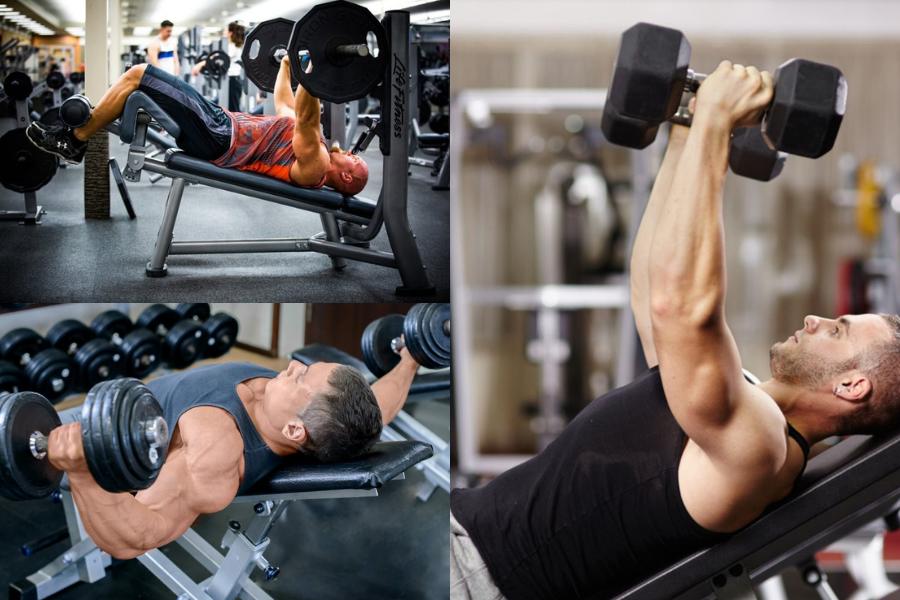
The barbell bench press is a staple in almost every chest routine for a reason. It trains your entire chest along with the front of your shoulders and triceps, and the bar lets you use heavier loads than dumbbells, which is ideal for strength and power gains.
To make the most of it, focus on your setup:
- Retract your shoulder blades by pinching them together on the bench
- Plant your feet firmly and keep a light arch in your lower back
- Lower the bar under control to mid chest, keep elbows at a comfortable angle
- Drive the bar up by pushing the floor away and squeezing your chest, not by bouncing
Retracting your scapula helps you load the chest instead of dumping stress into your shoulders. It also improves activation of the inner, upper, and outer pecs during the press.
Incline dumbbell bench press
Most men under train the upper chest. That is a mistake, because a well developed upper chest gives your torso a higher, more athletic look and ties your chest into your shoulders and traps.
The incline dumbbell bench press, set at about 30 to 45 degrees, is one of the best upper chest moves you can use. Gymshark notes that this angle targets the clavicular fibers of the pec more effectively and the dumbbells give you a larger range of motion and help fix side to side imbalances.
Keep your elbows under your wrists, lower the dumbbells until your chest is comfortably stretched, and then press up while thinking about driving your biceps toward each other at the top. That cue helps you feel the upper chest working, not just your shoulders.
Reverse grip bench press (optional variation)
If straight bar benching bothers your shoulders or you want an extra upper chest tool, try the reverse grip bench press. You hold the bar with an underhand grip, which tends to keep your elbows closer to your torso.
Research in the Journal of Strength & Conditioning Research shows that this variation boosts upper chest and biceps activation compared to the standard bench. Use a spotter at first, since the grip can feel awkward, and start lighter than your usual bench weight.
Shape and isolate with key accessory moves
Once you have your main presses in place, you can add exercises that keep constant tension on the pecs and train them through different angles.
Dips for lower chest
Bodyweight dips with a forward lean are excellent for targeting your lower chest. Gymshark recommends them as a primary lower chest builder and notes that you can progressively overload by adding a dip belt or attaching resistance bands for more difficulty.
To hit the chest instead of the triceps, lean slightly forward, let your elbows flare just a bit, and think about driving your torso up and away from the bars. If your shoulders are sensitive, keep the range of motion a little shorter at the bottom.
Cable fly variations
Cables shine for chest work because they provide constant tension that free weights sometimes lose at the top. That matters, since tension tends to drop off in dumbbell flyes or near lockout in presses when the triceps take over.
Useful angles include:
- Low to high cable fly for upper chest
- High to low cable fly for lower chest
- Straight across fly for mid chest
The low to high cable fly, where your hands travel from beside your thighs up toward eye or forehead level, is especially effective for the upper chest. Studies like Schütz et al. (2022) note that this larger range of motion and constant tension drive greater activation in the clavicular fibers.
Dumbbell flyes
Dumbbell flyes remain a classic for a reason. They make you focus on stretching and then squeezing your pecs, rather than just moving weight. Use relatively light dumbbells, keep a slight bend in your elbows, and stop before your shoulders feel unstable at the bottom.
Think of them as a finishing move, not your main lift. A few controlled sets at the end of the workout can help round out your chest without overstressing your joints.
Build stability and mind muscle connection
If you struggle to feel your chest working, especially when you bench, you might be relying too much on machines or chasing numbers over tension.
Machines are useful tools, and machine chest presses are great when you want to safely push close to failure without a spotter. However, relying on them for all your pressing limits the stabilizing work that free weights force your body to do. Historically, the best chests have been built mostly with barbells and dumbbells, not machines.
Include stability focused moves like:
- Dumbbell chest press on a flat or incline bench
- Single arm dumbbell bench press
- Pushups where you actively squeeze your hands toward each other
These exercises teach you how to control the weight and feel tension across the chest. That mind muscle connection helps you avoid what lifters call “working the weight, not the muscle”, where you use momentum and speed to finish reps instead of actually loading the pecs.
Sample gym workout for size and strength
You can build a strong routine around 4 to 5 movements. Aim for at least 10 sets per week for your chest across all exercises, which Gymshark highlights as a good minimum for growth when paired with progressive overload and twice weekly training.
Here is a simple gym day you can run once or twice each week:
- Barbell bench press
- 4 sets of 4 to 6 reps
- Rest 2 to 3 minutes
- Incline dumbbell bench press
- 3 sets of 6 to 10 reps
- Rest 90 seconds
- Weighted dips, forward lean
- 3 sets of 8 to 12 reps
- Rest 90 seconds
- Low to high cable fly
- 3 sets of 10 to 15 reps
- Rest 60 seconds
If you want extra volume, add a final high rep set of pushups to near failure.
Keep the weight heavy enough that the last 1 to 2 reps of each set are challenging, but not so heavy that your form breaks down. Avoid ego lifting. When the load is too high, your shoulders and triceps take over, your range of motion shrinks, and your risk of injury jumps.
Effective chest workout at home
You do not need a full gym to build a bigger chest. Bodyweight moves and simple equipment like bands can take you surprisingly far.
Try this home session:
- Decline pushups (feet elevated)
- 4 sets of 8 to 15 reps
- Focus on upper chest and front shoulders
- Standard pushups
- 3 sets of 12 to 20 reps
- Band resisted pushups
- 3 sets of 8 to 12 reps
- Loop a band across your upper back and hold the ends under your hands
- Hands elevated pushups (on a bench or sturdy chair)
- 2 sets close to failure for extra volume
Decline pushups are especially helpful for upper chest growth, because shifting your feet higher moves more load to that area. Men’s Health UK also highlights band resisted pushups and other advanced pushup variations, like typewriter and plyometric pushups, as powerful tools for building chest size and power at home.
Use intensity and progression the smart way
Once you have a routine in place, progress is not about random variety. It is about adding purposeful stress and then recovering from it.
You can progress by:
- Adding a small amount of weight week to week
- Adding a rep or two per set within the same weight
- Adding an extra set for a key exercise
Advanced intensity techniques such as drop sets, partial reps, or pauses in the stretched or contracted position can help you break plateaus. For example, you might perform a set of cable flyes to failure, then immediately reduce the weight and continue for more reps.
Use these tools sparingly. The goal is to stimulate growth, not to trash your joints or leave yourself too sore to train again that week.
Common mistakes to avoid
A few habits can quietly hold back your chest gains. Watch out for:
- Skipping the warm up and going straight to heavy benching
- Letting your shoulders roll forward instead of keeping your shoulder blades set
- Letting your hips bounce off the bench or using momentum to heave the bar
- Training chest hard once a week, then neglecting it for six days
- Never changing your exercise selection or rep ranges for months
Rotating your accessory lifts every 3 to 4 weeks, as many coaches recommend, helps keep progress moving. You might keep barbell bench as your main lift, but swap cable fly angles, fly variations, or pushup styles to expose your chest to new challenges.
Putting it all together
The best chest workouts for men are simple, consistent, and balanced. You press heavy to build strength, you use smart accessory work to hit every part of the chest, and you progress your volume and load over time.
Start by choosing one gym or home routine, and stick with it for at least 4 to 6 weeks. Track your weights and reps, pay attention to how your chest feels during each exercise, and adjust slowly. With that approach, your chest will not just get bigger. It will be stronger, more balanced, and built to last.
About the Author