A back workout with dumbbells is one of the simplest ways to build size, strength, and better posture without needing a barbell or cable stack. With a few smart exercises and attention to form, you can hit your upper, mid, and lower back in the same workout and make steady gains whether you train at home or in a busy gym.
Below, you will find a complete dumbbell back plan plus form tips to help you feel the right muscles and protect your spine.
Why train your back with dumbbells
If you usually default to pulldowns or the occasional machine row, switching to a dumbbell based back workout can surprise you with how effective it feels.
Dumbbells let each side of your body work on its own, which helps you spot and fix strength imbalances. They allow a larger range of motion than a barbell, so you can pull deeper and squeeze harder at the top of each rep. That extra stretch and squeeze increases muscle fiber recruitment across your lats, traps, and rhomboids, which supports more growth and better posture over time, as highlighted in Gymshark’s August 27, 2024 guide to dumbbell back training.
You also need very little equipment. A bench and a pair of adjustable dumbbells is enough for a full back session. This makes dumbbell back workouts ideal if you train at home, prefer quieter corners of a crowded gym, or just want a straightforward setup that you can stick to consistently.
Key muscles your back workout should target
Before you dive into sets and reps, it helps to know what you are trying to train. A good back workout with dumbbells should cover all major regions instead of hammering the same area over and over.
Upper back and traps
Your upper back includes the traps and rhomboids. These muscles pull your shoulder blades together and keep your shoulders from rounding forward. When they are strong, you look broader from behind and you stand taller without thinking about it.
Exercises like Kelso shrugs and chest supported rows hit this region hard. According to Gymshark, Kelso shrugs isolate the traps and rhomboids and can also help reduce neck and shoulder discomfort by improving upper back strength and posture.
Mid back and lats
This is where the width and thickness of your back really comes from. Your lats, mid traps, and rear delts all contribute to the V shape many men want. Single arm dumbbell rows, basic dumbbell rows, and renegade rows are your main tools here.
When you row correctly, you do not just train your back. You also challenge your core and grip, which pays off in other lifts.
Lower back and posterior chain
Your lower back is part of a larger system that includes glutes and hamstrings. Dumbbell Romanian deadlifts and pause Romanian deadlifts train this entire posterior chain. Gymshark notes that Romanian deadlifts build the erector spinae along with glutes and hamstrings, which improves posture and supports the spine when form is kept tight and the back remains neutral.
Strength in this area helps you handle heavier rows safely and reduces the risk of soreness from everyday tasks like lifting groceries or picking up your kids.
Best dumbbell exercises for your back
You do not need a long list of fancy moves. You just need a few heavy hitters and the discipline to perform them with control. The Gymshark guide identifies five key dumbbell back exercises for a complete upper, mid, and lower back workout:
- Kelso shrugs
- Single arm dumbbell row
- Chest supported dumbbell row
- Renegade row
- Dumbbell Romanian deadlift
Here is how to use them.
Kelso shrugs for upper back thickness
Kelso shrugs are performed on a 45 degree incline bench. You lie face down, chest against the pad, with dumbbells hanging straight down.
- Pull your shoulder blades back and slightly up, as if you are trying to pinch a pencil between them.
- Keep your arms mostly straight and let your traps and rhomboids do the work.
- Pause briefly at the top and then lower the weights under control.
Aim for 3 to 4 sets of 8 to 12 reps. If you do not have a bench, you can hinge at the hips and mimic the same motion from a bent over position, but still focus on squeezing the upper back instead of curling the weights.
Single arm dumbbell row for mid back focus
The single arm dumbbell row is one of the best back builders for men at all levels. It targets your lats, traps, and rhomboids, and because you work one side at a time, you can spot differences in strength or size and correct them.
- Place one hand and the same side knee on a bench or sturdy surface.
- Keep your other foot on the floor and hold a dumbbell in the free hand.
- Brace your core, keep your back flat, and let the weight hang straight down.
- Pull your elbow back toward your hip, not your ribcage, until the dumbbell reaches your side.
- Squeeze your back at the top, then lower with control.
Perform 3 sets of 8 to 12 reps per side. Choose a weight that lets you feel your back working with minimal body swing.
Chest supported dumbbell row for strict form
Chest supported rows remove momentum from the equation. You lie face down on an incline bench with dumbbells in each hand, and your chest glued to the pad. This setup forces your back to do all the work.
- Let the dumbbells hang under your shoulders with palms facing each other.
- Row both dumbbells up by pulling your elbows along your sides.
- At the top, pause briefly and squeeze your shoulder blades together.
- Lower slowly until your arms are straight again.
Go for 3 sets of 8 to 12 reps. Because you cannot cheat with your lower back, this is a great move to finish off your mid back once heavier rows are done.
Renegade row for back and core together
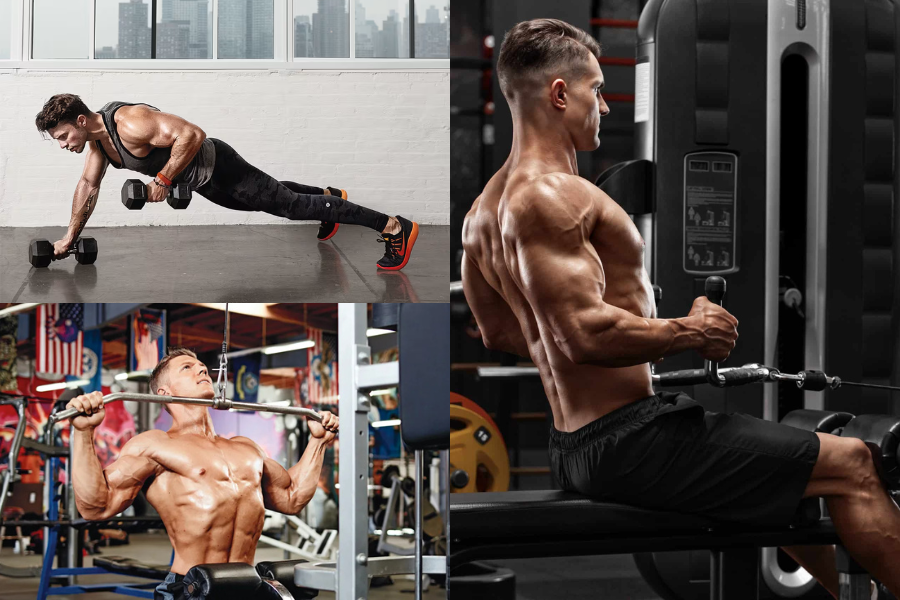
The elevated plank row or renegade row combines a plank hold with a rowing movement. You work your lats and mid back while also challenging your abs and anti rotation strength.
- Get into a high plank position with a dumbbell in each hand.
- Feet should be set wider than shoulder width for stability.
- Keep your hips level and your body in a straight line from head to heels.
- Row one dumbbell toward your hip, keeping your elbow close to your body.
- Lower it back down and repeat on the other side.
Start with 3 sets of 10 to 12 total reps, counting one rep each time you row on one side. Focus on minimal hip rotation. If your hips are twisting a lot, lower the weight.
Dumbbell Romanian deadlift for lower back and hamstrings
The dumbbell Romanian deadlift (RDL) is your main lower back and posterior chain builder. Gymshark highlights it as a key move for strengthening the erector spinae, lats, traps, glutes, and hamstrings, provided you keep a neutral spine and brace your core to avoid strain.
- Stand tall with dumbbells in front of your thighs, feet hip width apart.
- Soften your knees slightly, then hinge at the hips like you are closing a door behind you with your glutes.
- Keep your back flat and let the dumbbells travel down your legs.
- Stop when you feel a strong stretch in your hamstrings, usually around mid shin.
- Drive through your heels and push your hips forward to stand up, squeezing your glutes at the top.
Perform 3 to 4 sets of 8 to 10 reps. Keeping the dumbbells close to your legs and avoiding a rounded back is non negotiable. Rounding shifts tension off your glutes and hamstrings and dumps it into your spine, which increases the risk of injury.
A complete dumbbell back workout plan
Here is a simple but effective back workout with dumbbells that you can run 1 to 2 times per week. Adjust sets based on your experience level, but keep the exercise order roughly the same so you move from heavy to more controlled work.
| Exercise | Sets | Reps | Focus area |
|---|---|---|---|
| Dumbbell Romanian deadlift | 3–4 | 8–10 | Lower back, glutes, hamstrings |
| Single arm dumbbell row | 3 | 8–12 / side | Lats, mid back |
| Chest supported dumbbell row | 3 | 8–12 | Mid back, upper back |
| Kelso shrugs | 3–4 | 8–12 | Traps, rhomboids |
| Renegade row | 3 | 10–12 total | Back plus core |
Rest 60 to 90 seconds between sets. If you are new to back training, start at the low end of the set ranges. When you can hit the top end of the rep range with solid form, increase the weight slightly the next time.
Form tips to protect your spine and get better results
Good form is not just about avoiding pain. It is how you make sure the right muscles get trained hard enough to grow.
Keep your torso position honest
For bent over rows, if you stand too upright, your lats and mid back do not get much work. Instead, your traps and biceps take over. You will feel like you are moving weight, but your back will lag.
Hinge at the hips until your torso is close to parallel to the floor, brace your core, and keep that position as you row. Think about pulling with your elbows and squeezing your shoulder blades together on every rep.
Control the weight, do not swing it
If you are swinging the dumbbells or rocking your body just to complete reps, the weight is too heavy or your core is not braced. Momentum reduces muscle activation and raises your risk of tweaks, especially around the lower back.
Use a controlled tempo. Lift the weight in one to two seconds, pause briefly at the top, then lower in two to three seconds. This slow negative is where a lot of muscle building tension happens.
Learn to feel muscles instead of joints
If you feel rows mostly in your elbows or shoulders instead of your back, it is a sign that technique needs work. The same goes for RDLs. If you feel pressure in your lower back but not much in your hamstrings and glutes, you are probably rounding your spine or reaching too low.
A simple fix is to reduce the weight, cut the range of motion slightly, and focus on bracing your core as if someone is about to tap your stomach. Over time, you will learn what a properly loaded back rep feels like.
How to progress your dumbbell back training
You maximize your back gains when you combine consistent form with progressive overload. That does not mean maxing out every session. It means building small improvements week after week.
You can progress your dumbbell back workout by:
- Adding a small amount of weight once you can hit the top of the rep range with good form.
- Adding 1 or 2 reps per set with the same weight.
- Adding an extra set for one exercise in the workout.
- Slowing down the lowering phase for more time under tension.
Avoid changing everything at once. Pick one progression method, run it for several weeks, then reassess. The goal is to leave each workout knowing you challenged your back muscles without feeling wrecked.
Putting it all together
A smart back workout with dumbbells does not require special machines or hours in the gym. With Romanian deadlifts, rows, and shrugs in your weekly plan, you cover every major region of your back, build visible size, and support better posture.
Start by running the sample workout once a week, then move up to twice a week as your recovery improves. Pay attention to form, resist the urge to chase weight too fast, and focus on feeling your back do the work. Over the next few months, your shirts will fit differently across the shoulders and upper back, and you will notice daily tasks feel surprisingly easier.
About the Author