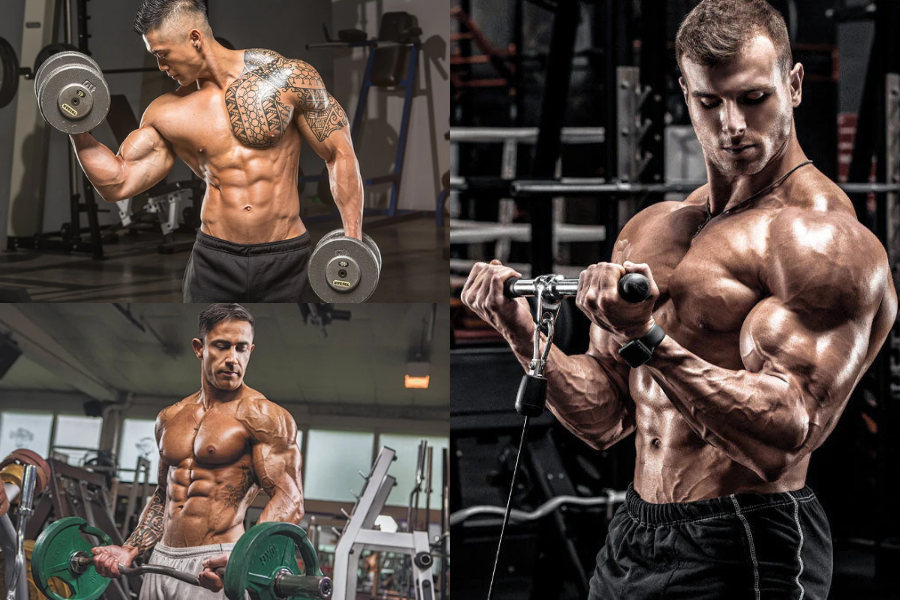
Arm workouts do more than build bigger biceps. When you train your biceps, triceps, and forearms with smart structure and good form, you make daily tasks easier, protect your joints, and create the kind of definition that shows even under a T-shirt.
Below, you will find simple, effective arm workouts you can plug straight into your week, plus clear form tips so every rep actually hits your arms instead of your shoulders or lower back.
Understand your arm muscles
Before you load up the weights, it helps to know what you are actually training. Your arm workouts should not be just curls on repeat.
Your upper arm has two main players. The biceps on the front bend your elbow and help with pulling movements. The triceps on the back straighten your elbow and help with pushing. Your forearms handle grip and wrist control, which is why they matter for almost every upper body exercise you do.
For balanced growth and strength, you want all three areas in the mix:
- Biceps for pulling and elbow flexion
- Triceps for pressing strength and lockout power
- Forearms for grip, stability, and a fuller looking arm
When you design your sessions around these roles, your arm workouts stop feeling random and start driving real progress.
Master bicep curl form
Curls look straightforward, but small changes in technique make a big difference in how much your biceps actually work.
According to Mayo Clinic, a basic dumbbell biceps curl starts with a dumbbell in each hand, palms facing up, elbows close to your body. You slowly curl the weight up by bending your elbow, then slowly lower it back down, keeping the movement controlled throughout.
Fixed elbows vs moving elbows
You have probably seen two camps of advice:
- Keep your elbows glued to your sides
- Let your elbows move slightly and bring the shoulder in
Online discussions highlight that both approaches can work. A Reddit thread comparing different videos and guides concluded that curls with fixed elbows and curls with a bit of elbow travel can be effective, depending on your goals and comfort level.
Here is how to use each approach:
- If you want to really isolate the biceps, keep your elbows about under your shoulders, avoid swinging, and stop just before your shoulder wants to roll forward.
- If you want to handle a bit more weight and bring the front of your shoulder into play, you can let your elbow drift slightly forward at the top, as long as you are not jerking the weight up from your hips or lower back.
Neither method is magic. What matters most is that your elbow is the pivot point, not your whole body. Fitness coach Ebenezer Samuel notes that when curls start from your hips or shoulders, other muscles take over and your biceps lose much of the training effect.
Simple form cues that protect your elbows
During curls, use these checkpoints so your joints stay happy and your biceps get the work:
- Keep your elbow near your side, not floating far in front or behind your body
- Keep your wrist straight, do not let it bend back or forward as you curl
- Move slowly, especially on the way down, so you are not just dropping the weight
- Avoid swinging your torso or using your hips to launch the weight
Smooth, controlled reps also help you feel the muscle working, which makes each set more productive.
Build a beginner arm workout
If you are new to lifting or coming back after a break, you do not need a complicated routine. A basic beginner arm workout can take as little as 20 minutes and only requires a pair of dumbbells.
Experts in a Peloton training article point out that building arm strength pays off in everyday life, from carrying bags and lifting boxes to pushing open heavy doors. You also stabilize your shoulders, elbows, and wrists, which lowers your risk of overuse issues like tennis elbow or shoulder impingement.
How often to train as a beginner
For most beginners aiming for strength and muscle:
- Train arms 1 to 2 times per week
- Do 2 to 3 sets of 10 to 12 reps per exercise
- Choose a weight that makes the last 2 to 3 reps feel challenging but still controlled
Verywell Fit suggests that beginners who want to add muscle should not train biceps every day, because muscles grow when you rest and recover, not during the workout itself. Let at least 48 hours pass before you hit the same muscle group again.
Sample beginner dumbbell arm workout
Here is a simple structure you can follow twice a week:
- Dumbbell biceps curl
- Dumbbell hammer curl
- Bench or chair bodyweight triceps dip
- Dumbbell overhead triceps extension
- Bent over dumbbell row
- Dead hang from a pull up bar (for grip and forearms)
Perform 2 sets of 10 to 12 reps for the first four exercises. For rows, also do 2 sets of 10 to 12. For dead hangs, hold as long as you can with good form. Rest 45 to 60 seconds between exercises and 60 seconds between rounds.
This routine hits your biceps, triceps, and forearms while also involving your back and shoulders for better overall strength.
Progress to bigger, stronger arms
Once the basics feel easy, the next step is to increase the challenge. You can do that with more weight, more sets, more frequent sessions, or tougher variations.
Research summarized by Gymshark suggests that training your biceps two to three times per week produces more hypertrophy than just once weekly, as long as you can still recover between sessions. The same idea applies to your triceps.
Weekly structure for size and strength
For arm growth, you can use a simple split like this:
- Day 1: Chest, shoulders, and triceps
- Day 2: Back and biceps
- Day 3: Legs
- Optional Day 4: Full body with lighter arm work
This way, you hit biceps and triceps directly 2 times per week and they also get extra work during big compound lifts like push ups, presses, and rows. This structure lines up with advice from multiple sources that recommend 2 to 3 arm focused sessions per week for size and strength, while still prioritizing full body training.
Focused arm hypertrophy workout
On an arm emphasis day, try this structure:
- Barbell or EZ bar curl
- Dumbbell hammer curl
- Cable or band curl
- Skull crusher or lying triceps extension
- Cable triceps pushdown or band pressdown
- Triangle pushup or close grip pushup
Do 3 sets of 8 to 12 reps for each exercise, resting 60 to 90 seconds between sets. Choose a weight that makes the last two reps feel very demanding while you still control the movement.
An American Council on Exercise study found that concentration curls are especially effective for biceps activation, and a separate ACE study reported that the triangle pushup is one of the best options for triceps engagement. You can rotate these into your routine when you want to isolate each muscle more directly.
Target biceps, triceps, and forearms
You do not need a long list of exercises, but knowing what each move emphasizes helps you build the right mix for your goals.
Here is a quick comparison of key arm moves and what they focus on:
| Exercise | Main focus | Notes |
|---|---|---|
| Barbell or EZ bar curl | Both biceps heads | Wider grip targets short head more, closer grip shifts toward long head |
| Concentration curl | Biceps short head | Great for mind muscle connection and isolation |
| Hammer curl | Biceps long head, brachialis, brachioradialis | Neutral grip helps fill out upper and lower arm |
| Cable curl | Biceps long head | Constant tension across the full range of motion |
| Skull crusher | Triceps long and lateral heads | Emphasizes the back of the upper arm |
| Cable triceps pushdown | Triceps lateral head | Grip variations shift emphasis slightly |
| Overhead triceps extension | Triceps long head | Stretches the muscle for a strong contraction |
| Wrist curl and reverse curl | Forearm flexors and extensors | Supports grip strength and elbow health |
| Farmer’s carry | Whole forearm and grip | Also challenges core and posture |
When you put a workout together, aim for:
- 2 to 3 biceps exercises
- 2 to 3 triceps exercises
- 1 to 2 forearm focused movements
This gives you full coverage without turning your session into a marathon.
Use supersets to save time
If you want bigger arms but do not have time for long gym sessions, supersets are a smart tool. A superset simply means doing two exercises back to back with little or no rest.
There are two useful ways to use them:
- Antagonist supersets: pair a biceps exercise with a triceps exercise, for example barbell curls followed by triceps pushdowns
- Agonist supersets: pair two exercises for the same muscle, such as hammer curls followed by concentration curls
Five time Classic Physique champion Chris Bumstead often uses this approach to increase training density and keep intensity high without spending hours on isolated moves. You can do the same by pairing exercises that use different muscles so one recovers while the other works.
For example:
- Superset A: Barbell curl + Triangle pushup
- Superset B: Hammer curl + Overhead triceps extension
- Finisher: Wrist curl + Farmer’s carry
Perform 3 rounds of each superset, resting 60 seconds between rounds. This structure keeps your heart rate up and makes your workout more efficient.
Avoid common arm training mistakes
You can put in a lot of effort and still see little change if your technique and structure are off. Several coaches highlight the same issues over and over.
Here are the mistakes to watch for and what to do instead:
- Swinging the weight: If you are using your hips and lower back to move the bar, drop the weight. Use a load you can control through the full range.
- Rushing reps: Very fast reps reduce time under tension. Aim for a 1 to 2 second lift and a 1 to 2 second lowering phase so the muscle actually works.
- Only training arms: Big compound lifts like rows, presses, and pull ups are essential for maximum arm size and strength. Slot arm work after those bigger movements.
- Training arms too often: More is not always better. Matt Harras from Virgin Active recommends training arms at most two focused days per week so they can recover and grow.
- Chasing spot fat loss: You cannot burn fat only from your arms. Visible arm definition depends on overall body fat levels plus muscle building. Combine your arm workouts with a solid nutrition plan and full body strength and cardio for best results.
When you fix these mistakes, you often see better results without adding extra sets or workouts.
Put your arm workouts into action
You do not have to overhaul your entire routine overnight. Start with one small change that fits your current training.
You might:
- Add 2 sets of hammer curls and triceps pushdowns after your next upper body session
- Swap rushed, swinging curls for slower, controlled reps and a lighter weight
- Choose one dedicated arm workout each week where you focus on curls, extensions, and a grip move like farmer’s carries
As you get stronger, increase the weight gradually, add an extra set, or introduce a new variation like concentration curls or triangle pushups. With consistent effort, smart structure, and attention to form, your arm workouts will start to translate into real strength and noticeable size in your biceps, triceps, and forearms.
About the Author