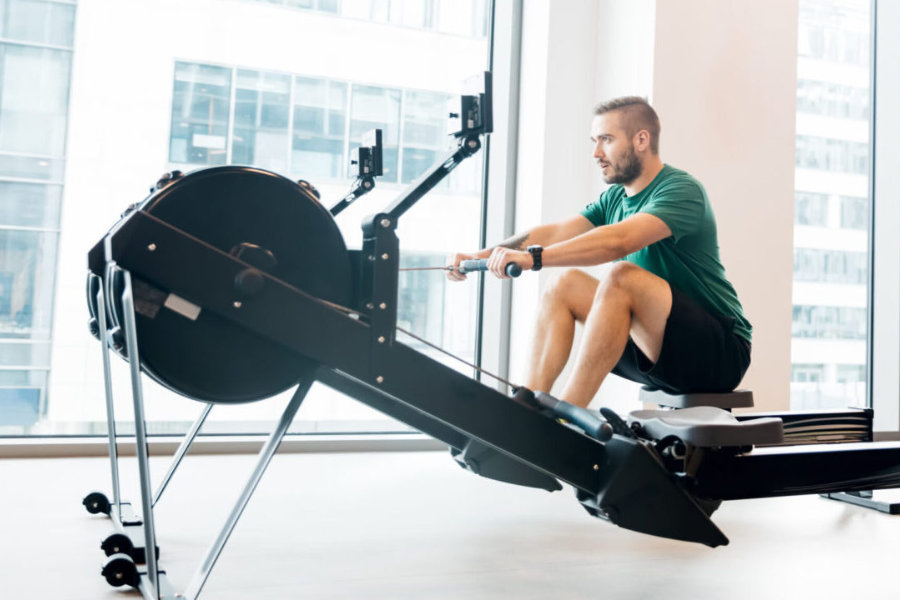
Indoor rowing workouts offer a powerful and joint-friendly way to challenge your heart, build muscle, and boost endurance. Whether you are short on gym time or looking for a fresh addition to your fitness routine, a rowing machine can quickly become your go-to piece of equipment. By combining full-body engagement with minimal impact, rowing can help you burn calories, strengthen your core, and sharpen your cardiovascular health at the same time. Below, you will find practical tips and straightforward workout ideas that make it easy to get started.
Embrace the cardio benefits
Many men gravitate toward running or biking for cardio, but rowing has unique advantages worth exploring. Since a rowing stroke engages your legs, back, shoulders, and core, it instantly becomes a total-body workout. With this effort spread across multiple muscle groups, you can sustain higher intensities longer than if one muscle set were doing all the work. This balanced demand can translate into greater calorie burn in less clock time.
You will also appreciate the lower impact rowing offers compared to pounding the pavement. Each stroke places much less stress on your knees and ankles, which is especially helpful if you have a history of joint discomfort or simply want to avoid potential overuse injuries. Within minutes, your heart rate climbs, raising your cardiovascular conditioning without punishing your joints.
Another reason to try indoor rowing workouts is that they suit virtually any location or schedule. You can row at home or at your local gym, day or night. You control the pace, resistance level, and duration. By adjusting workouts for intensity, you decide whether to push yourself like an elite athlete or gently reintroduce exercise after a break.
Set up your rowing machine
Launching into a rowing session without proper setup can leave you feeling uncomfortable and reduce the positive benefits of each stroke. Before your first workout, spend a few minutes adjusting the equipment settings to get everything just right.
- Check footplate height: Make sure your feet are secure in the straps and positioned so your knee can bend comfortably at the catch (the start of each stroke). You should feel stable without having your heel lift excessively.
- Adjust the damper: The damper or resistance control sets how heavy the rowing stroke feels. Beginners might try a setting around 3-5 to maintain a fluid, manageable motion.
- Confirm handle position: Grasp the handle with a shoulder-width grip and a relaxed wrist. Keep your shoulders and chest open so you can drive back with full power.
- Secure the seat track: Double-check that the seat slides smoothly along the track. A dusty or sticky track can tug on your lower back and disrupt your form.
When everything is aligned, you reduce the risk of straining your knees or lower back and maximize the power output of each stroke. Proper adjustments help you row with confidence, which in turn encourages you to row more often.
Master the basic rowing stroke
Form is crucial in any workout, but particularly for rowing, because it is a repetitive motion that challenges your entire body. To master the basic rowing stroke, break down each phase of the movement and focus on keeping your form tight:
• The catch: Your knees are bent, shins nearly vertical, and arms extended forward holding the handle. Lean slightly forward from your hips. This is your coiled-spring position.
• The drive: Begin by pushing forcefully with your legs, then allow your torso and arms to do their part. Imagine your legs initiating the sequence, followed by your back pivoting from slightly forward to slightly backward, and finally your arms pulling the handle toward your ribcage.
• The finish: Your legs are fully extended, torso leaning back a bit, and handle at or just below chest level. Keep your core engaged and your shoulders relaxed.
• The recovery: Let your arms extend first, then hinge forward from the hips, and finally bend your knees. You return to the catch position smoothly, ready for the next stroke.
Keep your chest up and your shoulders away from your ears throughout each repetition. It helps to visualize driving through your heels so you feel the power come from your legs. Practicing with slow, deliberate strokes at first often improves muscle memory. You can build up speed once you are comfortable.
Try a beginner-friendly workout
Once you have the gym set up and your stroke refined, it is time to row. As a newcomer to indoor rowing workouts, aim to keep your first few sessions short and forgiving. You want to finish each workout feeling motivated rather than exhausted.
Start with a 10-minute session at a moderate pace. For the first two minutes, row gently to warm up your muscles. Maintain a smooth, relaxed stroke rate and focus on form. Increase your intensity slightly from minutes three to seven, imagining you are cruising along a lake at a pace you can sustain without gasping for air. During the final few minutes, ease up again to cool down.
Spend several sessions at this level, increasing your total time by one to two minutes as you gain stamina. You also have the option of sprinkling short breaks into those 10 minutes or even pausing to stretch if you notice any tightness. In the long run, consistency is more valuable than pushing yourself too hard, too soon.
Shift to high-intensity intervals
Once you are comfortable rowing for 10 to 15 minutes at a steady pace, interval training can take your fitness to a whole new level. By alternating bursts of high-intensity effort with short recovery periods, you challenge both your aerobic and anaerobic systems, leading to faster improvements in endurance and strength.
A simple interval session might look like this:
• Warm up for 3 minutes at a light pace.
• Row hard for 30 seconds, giving about 80-90 percent of your maximum effort.
• Row gently for 30-60 seconds to recover your breath.
• Repeat for 8 to 10 cycles.
• Cool down with 2 minutes of easy rowing.
During those 30-second hard intervals, maintain good form rather than flailing your arms. It helps to keep your stroke rate consistent and row with purpose. Each burst challenges your muscles and your heart, but you still want the movement to look and feel controlled.
As your capacity grows, experiment with different work-to-rest ratios. For instance, you might row hard for 45 seconds and rest for 45 seconds, or lengthen your active interval to 60 seconds for an even bigger challenge. Interval workouts also tend to keep you mentally engaged since there is always another push or recovery just around the corner.
Stay consistent for long-term gains
Like most exercise regimens, indoor rowing workouts provide the best returns when you give yourself time to adapt and progress. Making rowing a regular part of your weekly routine prevents plateaus and helps your body continue reaping benefits. It is also a great way to keep fitness fun and varied, especially if you alternate rowing days with weight lifting, running, or other forms of cardio.
If you want to emphasize muscle definition, consider pairing rowing with bodyweight exercises or free-weight circuits on alternating days. Combining both cardio and strength training can amplify the positive impact on your body composition. You will notice better stamina, less fatigue in everyday tasks, and potentially better posture as you build back and core stability.
Aim to row two or three times a week if you are balancing other workouts, or four times if rowing is your main focus. You might do a steady-state workout early in the week, tackle intervals mid-week, and finish with a higher-intensity session on the weekend. Your body will adapt to consistent rowing by improving lung capacity, muscle endurance, and overall coordination with each stroke.
Remember to pay attention to how you feel, morning to night. If you find your muscles are especially sore or you are low on energy, a lighter row or a rest day can help you rebound. Meanwhile, if you continue improving and feel strong, challenge yourself by adding time or intensity. The key is to remain flexible and listen to your body while still maintaining a solid workout rhythm.
Incorporating indoor rowing workouts into your fitness plan can transform how you look and feel. Each session drives your heart rate up, taxes multiple muscle groups, and spares your joints from excessive strain. Take your time with the initial learning curve, follow the proper technique, and use short, structured routines to keep you motivated. With consistency and a willingness to push your limits at the right times, rowing has the potential to become one of your favorite ways to stay healthy for the long haul.
About the Author