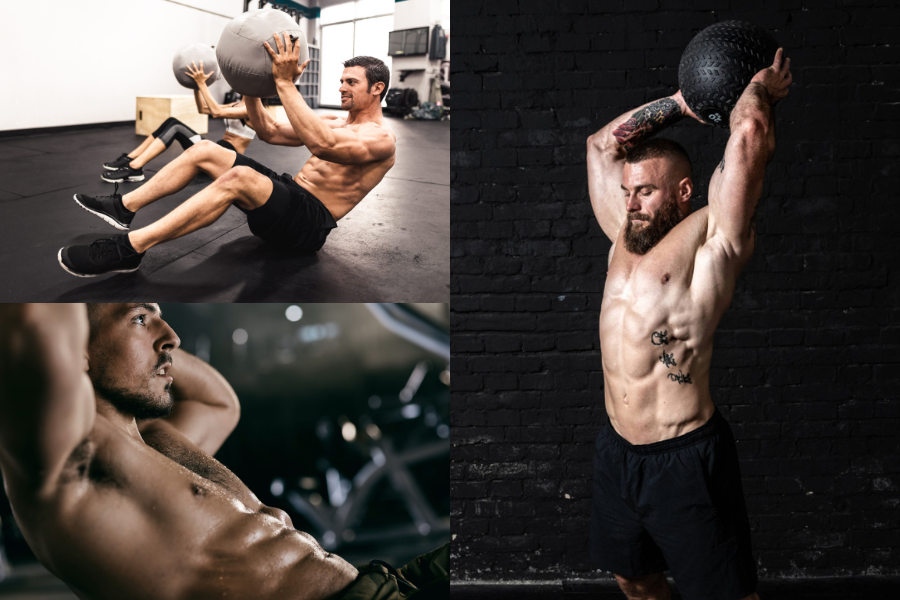
A stronger core does much more than carve out a six pack. The right ab workouts for men can improve posture, support your spine, and help you move with more ease. With a few simple exercises that target the deep core muscles, you can stand taller and feel more stable in everyday life and in the gym.
Below, you will learn how your core actually supports posture, why relaxing it matters as much as strengthening it, and a practical ab routine you can start using today.
Understand how your core affects posture
When you think about ab workouts for men and posture, you might picture crunches and sit ups. Those hit the surface muscles you can see, but posture relies heavily on the deeper layers.
Meet your deep core muscles
Under your visible abs sit the deep postural muscles that wrap around your middle like a built in corset. These include muscles in your abdomen, pelvis, and back. They work together to hold your torso steady as you walk, lift, and rotate.
One key player is the transverse abdominis. It is the deepest abdominal muscle and it wraps around your trunk like a wide belt. Research shows that strengthening this muscle improves trunk stability and postural control, especially on unstable surfaces such as a Swiss ball.
When these deep muscles are strong and responsive, your spine is supported and you can maintain an upright position with less effort.
Why imbalances cause slouching and strain
If your core is weak or imbalanced, other muscles start to pick up the slack. For example, tight hip flexors and overworked lower back muscles can pull your pelvis forward, which may make your lower back arch and your shoulders round.
Repeated over time, this pattern can contribute to poor posture and discomfort. Several physiotherapy sources note that weak stabilizing muscles in men who sit a lot can lead to sagging spines and chronic lower back pain, because those deep muscles are not doing their job.
The solution is not only more ab exercises, but the right kind that train your whole core to work as a team.
Rethink “perfect posture” and core tension
You might assume that perfect posture means sitting or standing bolt upright with your abs braced hard all day. Current research suggests that is not the case.
There is no one perfect way to sit or stand
A 2024 review from Cambridge University Hospitals reports that there is no strong evidence that any single posture causes back or joint pain, and there is no one ideal posture that everyone should hold all the time. Instead, the problem often comes from staying in one position for too long.
This is good news for you. It means you do not have to obsess over a rigid, textbook pose. You can focus on moving often, building strength, and finding positions that feel comfortable and sustainable.
Why over bracing can make things worse
If you live with persistent pain or worry about your back, you may unconsciously clench your core all the time. According to the same review, that constant tension can actually increase discomfort because the muscles never get a chance to relax.
For some people, Pilates or classic core programs can even make pain worse if they encourage more overactivity in muscles that are already gripping too much.
So, while ab workouts for men and posture do go hand in hand, you will get better results if you learn to:
- Activate your core when you need it, for lifting or balancing
- Let it relax when you do not, such as when sitting or lying down
The goal is a responsive core, not a permanently tightened one.
Think of your core like a dimmer switch, not an on or off button.
You want to be able to turn it up when you need strength, and turn it down when you need ease.
Focus on the muscles that matter for posture
Your core is more than the six pack. Training all of the key muscles gives you better posture, balance, and performance.
Front, side, and back of your core
Here are the main muscle groups to pay attention to:
-
Rectus abdominis
The “six pack” on the front of your torso. It helps you flex your spine, such as in a crunch. -
Obliques
These run along the sides of your torso. They help you rotate, bend, and stabilize side to side. Exercises like side planks and Pallof presses challenge them effectively, and they are important for keeping your torso steady when you twist. -
Transverse abdominis
This deep abdominal layer wraps around your waist and acts like a natural back brace. Studies on selective deep abdominal exercises, such as abdominal drawing in, show that this muscle thickens and activates without overusing the outer abs. That leads to better lumbar stability in both men and women. -
Spinal erectors
These muscles run along your spine and keep you upright. Bird dog and back extension movements help them work with your abs for balanced support. -
Glutes
Your glutes are technically hip muscles, but they are key for posture. Strong glutes support your pelvis and take pressure off your lower back. As Marvin Burton of Anytime Fitness UK notes, building a solid core can help correct the forward pulling and rounding of the shoulders that many men develop, and strong glutes play a big part in that alignment.
When you train all of these areas, you create a stable base for your entire body, not just a stronger midsection.
Learn proper core engagement for better posture
Before you jump into a full workout, it helps to practice what good core engagement feels like. This is especially useful if you are used to either ignoring your core or clenching it as hard as possible.
Try the basic drawing in drill
Lie on your back with your knees bent and feet on the floor. Slide a hand under your lower back. Then gently press your lower back down into your hand so it cannot move freely.
You should feel your deep abs tighten slightly, not in a hard crunch, but in a gentle brace. This technique is similar to the abdominal drawing in exercise used in research to selectively target the transverse abdominis and improve trunk stability.
Practice breathing while you hold this light brace. You want your core to stay active while your ribs and belly can still move with the breath.
Stand tall without over squeezing
When you stand, think about:
- Keeping your weight evenly distributed on both feet
- Softly tightening your core as if you are about to cough
- Letting your shoulders relax instead of pulling them back aggressively
This kind of active, relaxed posture helps your abs support your spine without creating extra tension.
Follow this posture friendly ab workout
The following routine focuses on ab workouts for men who want better posture and core stability. You can do it 2 to 4 times per week, either as a stand alone session or at the end of your regular workout.
Start with a light warm up such as 3 to 5 minutes of brisk walking, marching in place, or gentle mobility work.
Core stability circuit
Perform these exercises as a circuit. Do all sets of one exercise, then move to the next. Rest 30 to 45 seconds between sets.
- Forearm plank
Targets: Transverse abdominis, rectus abdominis, shoulders, glutes
- Set up on your forearms and toes, body in a straight line from head to heels.
- Gently brace your core and squeeze your glutes.
- Avoid letting your hips sag or piked up.
Beginner: 3 sets of 20 to 30 seconds
Intermediate: 4 sets of 30 to 45 seconds
Research and coaching guidance suggest that planks are excellent for practicing core bracing, which helps protect your spine during big lifts and daily tasks.
- Glute bridge
Targets: Glutes, hamstrings, lower back, transverse abdominis
- Lie on your back, knees bent, feet flat and hip width apart.
- Brace your core lightly, then drive through your heels to lift your hips until your body forms a straight line from shoulders to knees.
- Pause at the top for 1 to 2 seconds, then lower with control.
Do 3 sets of 10 to 15 reps.
Glute bridges support posture because strong glutes help keep your pelvis neutral and reduce stress on your lower back.
- Bird dog
Targets: Spinal erectors, glutes, transverse abdominis, shoulders
- Start on hands and knees, hands under shoulders, knees under hips.
- Brace your core so your back stays flat.
- Reach your right arm forward and left leg back, keeping your hips level.
- Hold for 2 to 3 seconds, then return to start and switch sides.
Perform 3 sets of 8 to 10 reps per side.
Bird dog is commonly used in lumbar stabilization programs and has been shown to improve trunk muscle thickness and control.
- Dead bug
Targets: Deep abs, hip flexors, spinal stabilizers
- Lie on your back with your arms straight up and knees bent to 90 degrees over your hips.
- Press your lower back gently into the floor using the drawing in technique.
- Slowly lower your right arm and left leg toward the floor without letting your lower back lift.
- Return to start and switch sides.
Aim for 3 sets of 8 to 12 reps per side.
This move teaches you to keep your spine stable while your arms and legs move, which is critical for posture during everyday activities.
- Bicycle crunch
Targets: Rectus abdominis, obliques
- Lie on your back with your hands lightly behind your head and legs raised, knees bent.
- Bring your right elbow toward your left knee while you extend your right leg.
- Switch sides in a controlled pedaling motion, not too fast.
Perform 3 sets of 12 to 20 total reps.
Bicycle crunches challenge your front abs and obliques, and when done with good form they support the overall core program.
Optional standing finisher
If you train in a gym, you can finish with a standing cable woodchop or Pallof press. Both exercises teach your core to resist unwanted rotation and extension, which is highly relevant for real life posture.
Cable woodchop: 2 to 3 sets of 8 to 12 reps per side
Pallof press: 2 to 3 sets of 10 to 15 seconds per hold
Experts recommend standing core work like this because it involves multiple joints and mimics everyday movements that require you to stabilize while you twist or reach.
Know when to get extra help
If you have ongoing pain or find that ab workouts seem to make you feel worse, it may be time to get support from a professional.
Some men benefit from postural therapy combined with targeted core strengthening, such as programs offered at centers like Texas Spine and Sports Therapy. These services can help you identify which muscles are overactive, which are underactive, and how to adjust your exercise routine so that it supports, rather than aggravates, your body.
Keep in mind that large reviews show Pilates or core specific workouts are no more effective for back pain than other types of exercise. In other words, you can improve posture and comfort with many forms of movement. The best choice is usually a mix of strength, cardio, and mobility that you enjoy and can stick with.
Build posture with consistency, not perfection
You do not need to chase a flawless pose or power through endless crunches. For better posture, focus on three simple habits:
- Train your whole core, front, sides, back, and glutes, a few times each week
- Practice light, smart core engagement instead of clenching all day
- Change positions and move often instead of staying stuck in one posture
If you start with the workout above and stay consistent, you will likely notice that sitting upright feels easier, standing for longer is more comfortable, and your body feels more stable overall.
Pick one or two of the exercises today, join them into a short routine, and see how your posture and confidence respond over the next few weeks.
About the Author