A strong core makes everyday life easier. It also helps you lift more in the gym, run faster, and protect your lower back. The good news is that you can build powerful abs at home, and you can do it with ab workouts for men without crunches.
Traditional crunches are not only uncomfortable for many people, they are also not your most effective option for strength, stability, or a visible six pack. You can get better results with movements that challenge your entire core from multiple angles, often with less strain on your spine and neck.
Below, you will find a simple guide to crunch free core training, plus specific workouts you can start today.
Why skip crunches altogether
Crunches are familiar, but familiar does not always mean effective.
Traditional crunches mainly work your abs in a short, flexed position. They do not challenge the muscles through a long range of motion and they provide limited tension over time, which makes them less effective for serious six pack training as of 2023. They also do not do much for the deep core muscles that stabilize your spine when you walk, lift, or twist.
Crunches can also be uncomfortable or risky for your lower back. According to Harvard Health Publishing, sit-ups and crunches can push your curved spine into the floor and overwork your hip flexors. When the hip flexors become too tight or strong relative to the rest of your core, they tug on the lower spine and can contribute to back discomfort or pain.
In contrast, plank style exercises and dynamic, full body core moves tend to:
- Spread the workload across the front, sides, and back of your core
- Encourage better posture and alignment
- Build strength you can actually use in daily life and sports
That is why experts now recommend plank based and functional core workouts over endless crunches for most men, especially if you already sit a lot or have any history of back issues.
How a strong core supports your body
Your core is more than just your abs. It includes the deep muscles around your spine, your obliques on the sides of your waist, and the muscles that connect your hips and ribcage. Together, they act like a central link between your upper and lower body.
Harvard Health Publishing notes that a strong core supports better posture, balance, and stability by helping you bend, reach, and stand upright with control. Over time, this can reduce your risk of falls and injuries, especially as you age.
When you train your core with smart, crunch free movements you are not just chasing visible abs. You are also:
- Making heavy lifts safer
- Protecting your spine when you carry groceries or kids
- Improving your performance in sports and workouts
- Supporting a more active, independent lifestyle as you get older
Think of every rep as an investment in how your body will feel five, ten, or twenty years from now.
Key principles for crunch free ab training
You do not need a complicated plan, but you do need a smart one. Keep these principles in mind as you build your ab workouts for men without crunches.
Focus on dynamic core movements
Core exercises that involve controlled movement, not just holding one position forever, tend to give you more strength and stability. Research highlighted by Harvard Health Publishing shows that dynamic movement patterns, such as plank variations, help strengthen the entire muscle set your body needs for everyday activities and sports.
Instead of holding a basic plank for several minutes, you will get more out of variations that involve reaches, taps, or hip movement.
Keep plank holds short but challenging
You might assume that a longer plank is always better. In reality, holding traditional planks beyond about 45 seconds is not very helpful for building six pack definition or serious core strength. After that point, you tend to compensate with other muscles instead of making your abs work harder.
A better approach is to:
- Hold strong, tight planks for 20 to 45 seconds
- Add dynamic variations like shoulder taps, arm reaches, or long lever planks
- Increase difficulty with movement, longer lever arms, or added resistance instead of only adding time
This keeps your sets focused and your form solid.
Train your core in all directions
Your abs help you flex, rotate, and resist movement. A balanced crunch free routine includes:
- Anti extension work, resisting your back arching, like regular planks
- Anti rotation work, resisting twisting, like Pallof presses
- Hip flexion work, lifting your legs toward your torso, like hanging or lying leg raises
- Lateral stability, resisting side bending, like side planks
When you challenge your core in all these ways, you get a stronger, more athletic midsection.
Think “brace, breathe, and move with control” instead of “yank your ribs toward your hips” like in a standard crunch.
Best crunch free ab exercises at home
You can mix and match the exercises below into your own routine or use the sample workouts later in this guide. Most require only your body weight, and a few can be made harder with simple equipment like dumbbells or a kettlebell.
Plank variations
Harvard Health Publishing recommends planks over sit-ups and crunches because they train a balanced set of muscles on the front, sides, and back of your body, not just one area.
Some options you can use:
- Elbow plank. Rest on your forearms and toes, forming a straight line from head to heels. This version tends to hit your abs even harder than a high plank in the top of a push up.
- High plank. Hands under shoulders, body straight, core braced. Easier on the shoulders for some people and a great starting point.
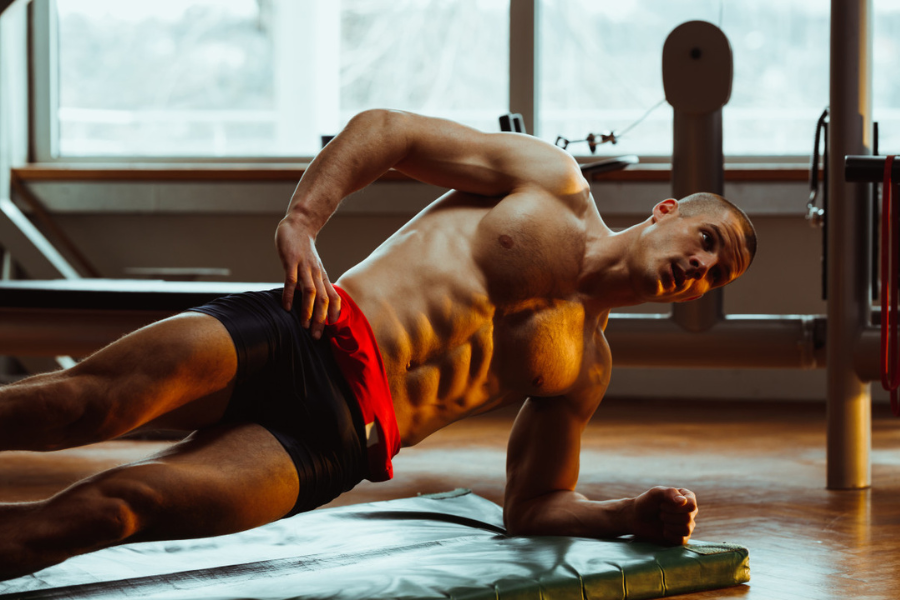
- Side plank. Lie on your side, then lift your hips so your body forms a straight line. This targets your obliques and the muscles along your spine.
- Plank and rotate. Start in a high plank, reach one arm to the ceiling, rotate your chest open, then return. This adds rotation and shoulder stability.
- Plank with alternating hip dips. From a forearm plank, gently rotate your hips side to side, bringing them toward the floor. This challenges your obliques and deeper spinal stabilizers.
Aim for sets of 20 to 40 seconds with perfect form rather than very long holds.
Bear crawl
The bear crawl turns a simple crawl into a powerful full core drill. You start in a wide push up position, then walk opposite hand and foot forward together. Keep your knees close to the floor, your back flat, and your core braced as if someone might tap your midsection at any moment.
This exercise trains your shoulders, abs, and hips at the same time. It also teaches you to coordinate opposite sides of your body, which carries over well to running and sports.
Bird dog
The alternating bird dog looks gentle, but it targets your deep core muscles very effectively. From a hands and knees position, extend your right arm forward and left leg back, then switch sides while keeping your hips level and your ribs pulled in.
The goal is to avoid any wobbling through your spine. This is a great option if you have a history of lower back discomfort and want to rebuild core stability without crunching.
Boat tucks
Boat tucks give you that “ab burn” many people expect from crunches, without forcing your spine into the floor. Sit on the floor, lean back slightly, and balance on your sitting bones. Bring your knees toward your chest as you draw your torso toward your thighs, then extend back out with control.
You can keep your heels lightly touching the floor to make it easier or lift your feet to increase the challenge.
Leg raise variations
When you think about “lower abs,” you are really thinking about how strongly the lower part of your rectus abdominis and nearby muscles can control your pelvis and spine. Leg raises are excellent for this if you do them with control.
Here are two options:
- Lying leg raises. Lie on your back, legs straight, hands lightly supporting your hips or by your sides. Lift your legs to about 90 degrees without swinging, then slowly lower them until you feel your lower back want to arch. Stop there, pause, and lift again. You can bend your knees to lower the intensity.
- Hanging leg lifts. If you have a pull up bar at home, this version is even more effective. According to research, hanging leg lifts are a superior option to reverse crunches for lower abs because they maintain continuous core tension, are more challenging, and make it harder to cheat. Focus on curling your pelvis under, rather than just swinging your legs.
Anti rotation work: Overhead Pallof press
Side bends are a common go to for obliques, but they often end up loading your lower back more than your abs.
Instead, try an overhead Pallof press. Anchor a band or use a cable if you have access to one, hold the handle at chest height, and stand side on to the anchor so the band tries to twist you. Press the band overhead and back down while resisting any rotation or side bending.
This overhead position keeps strong, constant tension on your abs and obliques throughout the set, making it a more effective alternative to side bends.
Mountain climbers and other athletic moves
Mountain climbers are a simple way to add speed and conditioning to your ab workouts for men without crunches. From a plank position, drive one knee toward your chest, then quickly switch legs like you are running in place. Keep your hips level and your lower back straight so your core does not relax.
You can combine mountain climbers with other athletic core drills like:
- Russian twists, seated on the floor, rotating your torso side to side. You can hold a medicine ball to increase difficulty and lift your feet slightly off the ground to engage your core even more.
- Frankensteins, standing tall and lifting one straight leg to meet the opposite hand. Focus on posture and keeping your hips square to the front.
- Inverted flyers, also known as single leg hinges. Stand on one leg, lean forward with a flat back, and extend your other leg behind you. Your core works hard to keep you balanced and aligned.
These movements challenge your stability in a way that feels more like real life.
Sample at home ab workouts without crunches
You can rotate the two routines below throughout the week. Both are designed to be done in about 15 to 20 minutes with minimal equipment.
Workout A: Plank and crawl focus
Repeat this circuit 2 to 3 times, resting 45 to 60 seconds between rounds.
- High plank
- 3 sets of 30 seconds
- Brace your core, squeeze your glutes, and keep your neck long
- Side plank
- 3 sets of 20 to 30 seconds per side
- Hips stacked, body in a straight line
- Bear crawl
- 3 sets of 20 to 30 seconds
- Move slowly at first, keeping your knees low and your back flat
- Bird dog
- 3 sets of 8 to 10 slow reps per side
- Pause briefly at full extension to challenge your balance
- Mountain climbers
- 3 sets of 20 to 30 seconds
- Move fast, but do not let your hips bounce up and down
Workout B: Lower abs and rotation
Repeat this circuit 2 to 3 times, resting 45 to 60 seconds between rounds.
- Elbow plank with alternating hip dips
- 3 sets of 20 to 30 seconds
- Gently tap hips side to side without losing tension in your midsection
- Lying leg raises
- 3 sets of 10 to 15 reps
- Control the lowering phase and stop before your back arches
- Russian twists
- 3 sets of 16 to 20 total twists
- Add a medicine ball if you have one
- Boat tucks
- 3 sets of 10 to 15 reps
- Keep your chest lifted and avoid collapsing your spine
- Overhead Pallof press
- 3 sets of 10 to 12 reps per side
- Move slowly and resist any rotation as you press overhead
If you prefer a more strength focused option with weights, the Everyday Abs Workout designed by Men’s Health fitness editor Andrew Tracey offers another crunch free template. It uses five weighted exercises, including overhead kettlebell presses, overhead kettlebell walks, kettlebell front squats, dumbbell bear crawls, and dumbbell press ups to target your core through full body, functional movements.
How often to train your abs
You do not need to hammer your abs every day to see results. Two to four focused sessions each week are enough for most men, especially when you are choosing higher quality crunch free exercises.
You can:
- Add one of the sample workouts to the end of your strength or cardio sessions
- Alternate Workout A and Workout B on different days
- Start with 2 sessions per week, then increase to 3 or 4 if you recover well
Pay attention to how your lower back and hips feel. Mild muscle soreness in your abs is normal, but sharp pain or joint discomfort is a sign to back off, review your form, or choose an easier variation.
Putting it all together
Ab workouts for men without crunches can be just as effective as traditional routines, and in many cases they are safer and more practical. By focusing on planks, crawls, leg raises, and anti rotation moves, you train your core to support your entire body, not just look good in the mirror.
Start simple. Pick three to five exercises from this guide, work through them with steady form, and give yourself time to progress. As Harvard Health Publishing notes, incorporating plank based and dynamic core exercises into your routine is a long term investment in your posture, mobility, and independence as you age.
Try one of the sample workouts this week and notice how your body feels during everyday tasks. You may find that carrying groceries, climbing stairs, or standing for long periods suddenly feels a little easier, all without a single crunch.
About the Author