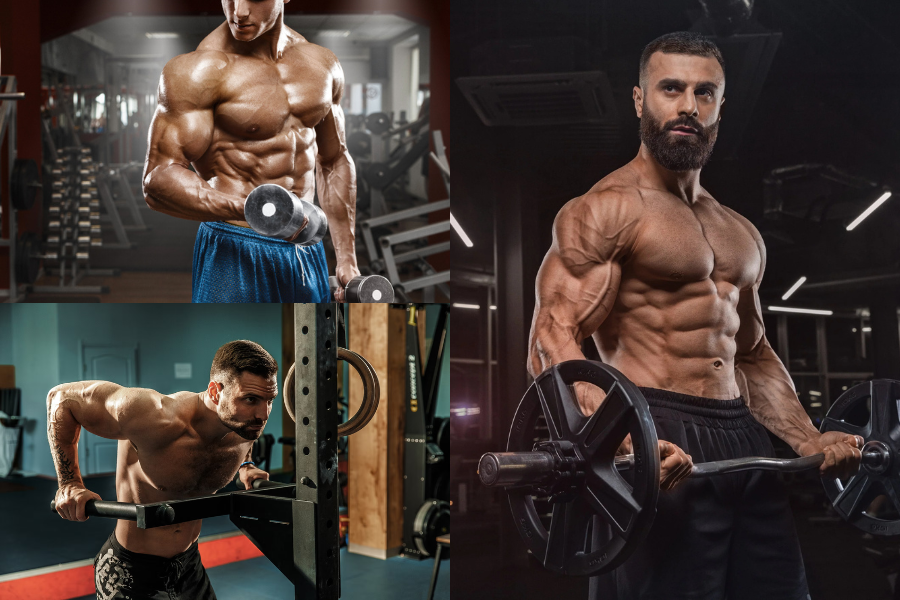
A solid arm workout does more than fill out your sleeves. The best arm workouts for men help you build strength for pulling, pushing, and lifting in everyday life, while also sculpting your biceps, triceps, and forearms so they look as strong as they feel.
Below, you will learn how your arm muscles work, which exercises deserve a place in your routine, and how to build weekly arm workouts that match your experience level and equipment.
Understand your arm muscles
Before you pick up a dumbbell, it helps to know what you are training. Effective arm workouts for men target three main areas.
Biceps
Your biceps sit on the front of your upper arm. They include:
- Biceps brachii, with a long head and short head
- Brachialis, which lies underneath the biceps
- Brachioradialis, which runs into your forearm
These muscles handle elbow flexion, like when you curl a weight. The most effective biceps routines hit both the long and short heads along with the supporting muscles so you build strength and full, rounded shape. A 2024 Gymshark guide notes that the best biceps workouts for men train all of these together for optimal size and strength.
Triceps
Your triceps are on the back of your upper arm and make up most of its total size. They have three heads and are responsible for straightening your elbow and assisting with pressing movements.
Focusing on triceps is essential if you want thicker arms, since they contribute around 60 percent of upper arm mass in many men. Training only your biceps will limit how big your arms can get, no matter how hard you curl.
Forearms and grip
Your forearms control wrist flexion, extension, and grip strength. Strong forearms support heavier pulls, rows, and curls. They also change how muscular your arms look as a whole.
Including grip and wrist exercises, such as farmer’s carries and wrist curls, helps develop balanced, functional arms and supports heavy lifts like deadlifts and pull-ups.
Why arm workouts for men should not be “arm day” only
You might have heard that you need a dedicated arm day. Sports scientist Dr Mike Israetel argues that this idea is outdated. Training biceps and triceps together in one long session can limit range of motion and reduce how much effort you can give each muscle because they recover at different rates.
Instead, you will usually see better results if you sprinkle arm work throughout the week.
Frequency that builds muscle
Research summarized in recent training guides suggests that training a muscle group two or more times per week supports more hypertrophy compared to once a week. For arms specifically:
- Biceps respond well to being trained 2 to 3 times per week
- Some coaches recommend 3 to 4 biceps sessions per week for advanced lifters, as long as total weekly volume is managed
- Triceps can often handle 2 to 3 sessions per week
You do not need marathon workouts. Short, focused arm sessions added to your main training days are usually more effective than a single high-volume arm day.
Best biceps exercises for size and strength
The best arm workouts for men include variety. The University of Tampa notes that hitting muscles from different angles leads to more effective growth in men aiming for bigger arms, and your biceps are no exception.
Barbell bicep curl
Often called the king of biceps exercises, the barbell curl lets you load the movement heavily while keeping tension fixed on the biceps.
- Stand tall, grip the bar slightly wider than shoulder width
- Keep your elbows close to your sides
- Curl the bar under control, squeeze at the top, and lower slowly
Using strict form prevents your shoulders from taking over and keeps the stress where you want it. Cheating early in the set by swinging your torso shifts work to your front delts, which reduces stimulus to the biceps and slows down gains.
Concentration curl
Concentration curls are excellent for targeting the short head of the biceps and improving mind muscle connection.
- Sit on a bench and brace your elbow against the inside of your thigh
- Curl the dumbbell slowly toward your shoulder
- Pause at the top, then lower with control
Use lighter weights and focus on 3 sets of 8 to 12 reps. The goal is isolation, not ego lifting.
Hammer curl
Hammer curls use a neutral grip, with palms facing each other. This position emphasizes the long head of the biceps and also trains the brachialis and brachioradialis for balanced arm growth.
You can perform them with both arms at once or alternating sides. Aim for 3 sets of 8 to 12 reps, keeping your elbows pinned at your sides.
Other useful curl variations
To fully recruit different fibers and avoid plateaus, rotate among:
- EZ bar curls, which let you experiment with wider and narrower grips
- Preacher curls, which prevent momentum and bias the short head
- Single arm high cable curls, which keep constant tension at the top of the movement
- Chin ups, which train long and short heads together depending on grip width
Be wary of myths like “preacher curls build lower biceps” or “concentration curls increase peak.” You cannot target specific regions of the same muscle. Focus on overall stimulus and progressive overload instead.
Best triceps exercises for bigger arms
Since triceps account for most of your upper arm mass, your arm workouts for men should center on them.
Close grip pressing
Any close grip pressing move hits the triceps hard while still training your chest and shoulders. Good options include:
- Close grip bench press
- Close grip push-ups
- Diamond push-ups, with hands close together under your chest
Diamond push-ups are especially useful if you train at home. You can modify the difficulty by dropping to your knees or using a wall if you are just getting started.
Dips
Bench dips and parallel bar dips are powerful compound exercises for triceps and also involve your delts and chest.
For beginners, bench dips are a great entry point:
- Place your hands on the edge of a bench behind you
- Keep your feet on the floor with knees bent
- Lower yourself by bending your elbows, then push back up
You can make these harder by straightening your legs on a second bench or adding a weight plate on your lap, as coach Ngo Okafor recommends in his beginner arm training routine discussed in Men’s Journal.
Triceps extensions and pushdowns
To directly isolate the triceps, include:
- Overhead triceps extensions with a dumbbell or cable
- Triceps rope pushdowns
- Skull crushers with a barbell or EZ bar
Combining heavy compound work like dips with isolation moves such as pushdowns helps you hit all three heads of the triceps for fuller development.
Do not skip forearms and grip
Forearms are often an afterthought, but they directly influence how strong your arms are and how they look.
Why forearms matter
Strong forearms support deadlifts, rows, pull-ups, and curls. They also play a major role in any sport that relies on grip, from climbing to grappling.
Including dedicated forearm work, such as farmer’s carries, towel grip pull-ups, and plate pinches, promotes overall arm development and helps you progress on heavier lifts that rely on grip strength.
Simple forearm training
Beginners can start with:
- Overhand wrist curls to train the top and outer forearms
- Underhand wrist curls to hit the underside
- Dead hangs from a pull-up bar
Verywell Fit suggests performing 3 sets of around 20 reps for wrist curls multiple times per week to noticeably improve forearm size and balance in beginners.
At home arm workouts for men
You do not need a gym membership to build impressive arms. Healthline notes that you can effectively strengthen and tone arm muscles at home using a mix of dumbbells, bands, kettlebells, and bodyweight exercises.
Bodyweight options
If you have no equipment, build a short routine around:
- Triceps dips using a stable chair or sofa
- Chaturanga or low plank holds to challenge triceps and shoulders
- Incline push-ups with hands on a bed or bench
- Handstand wall walks to overload your shoulders and biceps
- Shadow boxing intervals to combine arm endurance with cardio
A seven move bodyweight circuit that trains triceps, biceps, and forearms can be enough to grow muscle when you push close to failure and keep rest periods short.
Dumbbells and bands
With light to moderate weights, you can do:
- Standing overhead triceps extensions
- Dumbbell curls and hammer curls
- Zottman curls for forearms
- Resistance band bicep curls
- Band triceps kickbacks
Pair these with compound moves like farmer’s walks and squat to overhead press. These exercises train your arms and core together and provide a cardiovascular boost.
Sample beginner arm workout
If you are new to strength training, start with a simple routine two times per week. Verywell Fit suggests that beginners aim for 2 to 3 sets of 10 to 12 reps, with the last 3 reps feeling challenging but still doable.
Here is a beginner friendly session:
- Dumbbell biceps curls
- Dumbbell hammer curls
- Bench bodyweight triceps dips
- Diamond push-ups or standard push-ups
- Dead hangs from a bar or sturdy doorway pull-up bar
Perform 2 to 3 sets of each exercise, resting 60 to 90 seconds between sets. Choose weights that make the final few reps difficult without forcing you to break form. As you get stronger, gradually progress to heavier weights or more challenging variations to avoid plateaus.
If a set feels easy from the first rep to the last, you are not giving your muscles a clear reason to grow. Gentle discomfort near the end of a set is where progress happens.
Advanced arm training methods
Once you have built a base of strength and consistent technique, you can experiment with more demanding strategies.
Drop sets and multi grip sets
Trainer Jamie Inzani recommends using heavy drop sets and multi grip drop sets to recruit more muscle fibers and stimulate growth.
For example, on a cable curl:
- Start with a heavy weight for 6 to 8 strict reps
- Reduce the weight by 20 to 30 percent and immediately perform 8 to 10 more
- Drop the weight again and go for another 10 to 12 controlled reps
You can also change grips between drops, such as wide grip to narrow grip, to challenge both heads of the biceps.
The 5/20 Method finisher
For a quick but intense arm finisher, the 5/20 Method uses two short circuits, one for biceps and one for triceps. Each circuit includes four movements and ramps from low reps to high reps without rest.
Biceps circuit
Repeat 3 rounds, resting 90 to 120 seconds between rounds:
- Chin-ups, 5 reps
- Dumbbell curls, 10 reps
- Hammer curls, 15 reps
- Single dumbbell curls, 20 reps
Triceps circuit
Repeat 3 rounds with similar rest:
- Barbell triceps extensions, 5 reps
- Dips on parallel bars or between chairs, 10 reps
- Close grip push-ups, 15 reps
- Triceps press downs with cable or band, 20 reps
Perform this 10 minute finisher at the end of your upper body day to drive an intense pump and additional growth stimulus. If your arms feel fresh at the end, increase load next time.
Programming tips to avoid overtraining
Arm muscles are relatively small and can be overworked if you match the volume you use for larger groups like legs or back.
To keep progressing without burning out:
- Train biceps 2 to 3 times per week rather than with huge volume in one day
- Hit triceps at least twice weekly, paired with chest or shoulder days
- Limit total hard sets per muscle group per week to a level you can recover from, then increase slowly over time
- Change rep ranges periodically so you are not always doing only 5 to 8 or only 12 to 30 reps
Avoid using momentum for the entire set. You can allow a little body English only after you reach strict full rep failure to squeeze out an extra rep or two. Most of your work should use controlled form, full range of motion, and a strong squeeze at the top of each curl or extension.
Putting it all together
Effective arm workouts for men are built on a few simple principles:
- Train biceps, triceps, and forearms, not just curls
- Use a mix of heavy compound moves and focused isolation work
- Hit your arms at least twice a week with manageable volume
- Vary your exercises, grips, and rep ranges over time
- Progress weights or difficulty gradually, while keeping form strict
Start with a basic routine that fits your current strength and equipment. As your technique and confidence grow, layer in more advanced tools like drop sets and focused finishers.
You do not need marathon gym sessions to sculpt your arms. Consistent, smart training, week after week, is what transforms how your arms look and perform.
About the Author